
Desktop Commander MCP
About
This is MCP server for Claude that gives it terminal control, file system search and diff file editing capabilities
Details
- License
- MIT
Explore
- Remote AI Control - Use Desktop Commander from ChatGPT, Claude web, and other AI services via Remote MCP
- File Preview UI - Visual file previews in Claude Desktop with rendered markdown, inline images, expandable content, built-in markdown editor, and quick "Open in folder" access
- Enhanced terminal commands with interactive process control
- Execute code in memory (Python, Node.js, R) without saving files
- Instant data analysis - just ask to analyze CSV/JSON/Excel files
- Native Excel file support - Read, write, edit, and search Excel files (.xlsx, .xls, .xlsm) without external tools
- PDF support - Read PDFs with text extraction, create new PDFs from markdown, modify existing PDFs
- DOCX support - Read, create, edit, and search Word documents (.docx) with surgical XML editing and markdown-to-DOCX conversion
- Interact with running processes (SSH, databases, development servers)
- Execute terminal commands with output streaming
- Command timeout and background execution support
- Process management (list and kill processes)
- Session management for long-running commands
- Process output pagination - Read terminal output with offset/length controls to prevent context overflow
- Server configuration management:
- Get/set configuration values
- Update multiple settings at once
- Dynamic configuration changes without server restart
- Full filesystem operations:
- Read/write files (text, Excel, PDF, DOCX)
- Create/list directories
- Recursive directory listing with configurable depth and context overflow protection for large folders
- Move files/directories
- Search files and content (including Excel content)
- Get file metadata
- Negative offset file reading: Read from end of files using negative offset values (like Unix tail)
- Code editing capabilities:
- Surgical text replacements for small changes
- Full file rewrites for major changes
- Multiple file support
- Pattern-based replacements
- vscode-ripgrep based recursive code or text search in folders
- Comprehensive audit logging:
- All tool calls are automatically logged
- Log rotation with 10MB size limit
- Detailed timestamps and arguments
- Security hardening:
- Symlink traversal prevention on file operations
- Command blocklist with bypass protection
- Docker isolation for full sandboxing
- See SECURITY.md for details

Setting up with Highlight
This MCP is not yet compatible with Highlight’s one-click setup. However, you can still use it with Highlight by following these steps:
- Download and install Highlight from highlightai.com/download
- Navigate to the plugins tab and select "Add Custom Plugin"
-
Configure the plugin with the settings below
Plugin Name
Desktop Commander MCPCommand (node, npx, python, etc.)Please refer to the README for specific instructions on how to obtain API keys or other required environment variables.
- Enable "Start Automatically" if you want the plugin to start when Highlight launches





From the repository
Once Desktop Commander is installed and Claude Desktop is restarted, you're ready to supercharge your Claude experience!
Desktop Commander offers multiple installation methods for Claude Desktop.
> 📋 Update & Uninstall Information: Options 1, 2, 3, 4, and 6 have automatic updates. Option 5 requires manual updates. See below for details.
<details>
<summary><b>Option 1: Install through npx ⭐ Auto-Updates (Requires Node.js)</b></summary>
Just run this in terminal:
npx @wonderwhy-er/desktop-commander@latest setup
For debugging mode (allows Node.js inspector connection):
npx @wonderwhy-er/desktop-commander@latest setup --debug
Command line options during setup:
- --debug: Enable debugging mode for Node.js inspector
- --no-onboarding: Disable onboarding prompts for new users
Restart Claude if running.
✅ Auto-Updates: Yes - automatically updates when you restart Claude
🔄 Manual Update: Run the setup command again
🗑️ Uninstall: Run npx @wonderwhy-er/desktop-commander@latest remove
</details>
<details>
<summary><b>Option 2: Using bash script installer (macOS) ⭐ Auto-Updates (Installs Node.js if needed)</b></summary>
curl -fsSL https://raw.githubusercontent.com/wonderwhy-er/DesktopCommanderMCP/refs/heads/main/install.sh | bash
✅ Auto-Updates: Yes
🔄 Manual Update: Re-run the bash installer command above
🗑️ Uninstall: Run npx @wonderwhy-er/desktop-commander@latest remove
</details>
<details>
<summary><b>Option 3: Installing via Smithery ⭐ Auto-Updates (Requires Node.js)</b></summary>
1. Visit: https://smithery.ai/server/@wonderwhy-er/desktop-commander
2. Login to Smithery if you haven't already
3. Select your client (Claude Desktop) on the right side
4. Install with the provided key that appears after selecting your client
5. Restart Claude Desktop
✅ Auto-Updates: Yes - automatically updates when you restart Claude
🔄 Manual Update: Visit the Smithery page and reinstall
</details>
<details>
<summary><b>Option 4: Add to claude_desktop_config manually ⭐ Auto-Updates (Requires Node.js)</b></summary>
Add this entry to your claude_desktop_config.json:
- On Mac: ~/Library/Application Support/Claude/claude_desktop_config.json
- On Windows: %APPDATA%\Claude\claude_desktop_config.json
- On Linux: ~/.config/Claude/claude_desktop_config.json
{
"mcpServers": {
"desktop-commander": {
"command": "npx",
"args": [
"-y",
"@wonderwhy-er/desktop-commander@latest"
]
}
}
}
✅ Auto-Updates: Yes - automatically updates when you restart Claude
🔄 Manual Update: Run the setup command again
🗑️ Uninstall: Run npx @wonderwhy-er/desktop-commander@latest remove or remove the entry from your claude_desktop_config.json
</details>
<details>
<summary><b>Option 5: Checkout locally ❌ Manual Updates (Requires Node.js)</b></summary>
git clone https://github.com/wonderwhy-er/DesktopCommanderMCP.git
cd DesktopCommanderMCP
npm run setup
The setup command will install dependencies, build the server, and configure Claude's desktop app.
❌ Auto-Updates: No - requires manual git updates
🔄 Manual Update: cd DesktopCommanderMCP && git pull && npm run setup
🗑️ Uninstall: Run npx @wonderwhy-er/desktop-commander@latest remove or remove the cloned directory and MCP server entry from Claude config
</details>
<details>
<summary><b>Option 6: Docker Installation 🐳 ⭐ Auto-Updates (No Node.js Required)</b></summary>
Perfect for users who want isolation or don't have Node.js installed. Runs in a sandboxed Docker container with a persistent work environment.
Prerequisites: Docker Desktop installed and running, Claude Desktop app installed.
macOS/Linux:
bash <(curl -fsSL https://raw.githubusercontent.com/wonderwhy-er/DesktopCommanderMCP/refs/heads/main/install-docker.sh)
Windows PowerShell:
iex ((New-Object System.Net.WebClient).DownloadString('https://raw.githubusercontent.com/wonderwhy-er/DesktopCommanderMCP/refs/heads/main/install-docker.ps1'))
The installer will check Docker, pull the image, prompt for folder mounting, and configure Claude Desktop.
Docker persistence: Your tools, configs, work files, and package caches all survive restarts.
<details>
<summary>Manual Docker Configuration</summary>
Basic setup (no file access):
{
"mcpServers": {
"desktop-commander-in-docker": {
"command": "docker",
"args": ["run", "-i", "--rm", "mcp/desktop-commander:latest"]
}
}
}
With folder mounting:
{
"mcpServers": {
"desktop-commander-in-docker": {
"command": "docker",
"args": [
"run", "-i", "--rm",
"-v", "/Users/username/Desktop:/mnt/desktop",
"-v", "/Users/username/Documents:/mnt/documents",
"mcp/desktop-commander:latest"
]
}
}
}
Advanced folder mounting:
{
"mcpServers": {
"desktop-commander-in-docker": {
"command": "docker",
"args": [
"run", "-i", "--rm",
"-v", "dc-system:/usr",
"-v", "dc-home:/root",
"-v", "dc-workspace:/workspace",
"-v", "dc-packages:/var",
"-v", "/Users/username/Projects:/mnt/Projects",
"-v", "/Users/username/Downloads:/mnt/Downloads",
"mcp/desktop-commander:latest"
]
}
}
}
</details>
<details>
<summary>Docker Management Commands</summary>
macOS/Linux:
Desktop Commander works with any MCP-compatible client. The standard JSON configuration is:
{
"mcpServers": {
"desktop-commander": {
"command": "npx",
"args": ["-y", "@wonderwhy-er/desktop-commander@latest"]
}
}
}
Add this to your client's MCP configuration file at the locations below:
<details>
<summary><b>Cursor</b></summary><br>

Or add manually to ~/.cursor/mcp.json (global) or .cursor/mcp.json in your project folder (project-specific).
See Cursor MCP docs for more info.
</details>
<details>
<summary><b>Windsurf</b></summary>
Add to ~/.codeium/windsurf/mcp_config.json. See Windsurf MCP docs for more info.
</details>
<details>
<summary><b>VS Code / GitHub Copilot</b></summary>
Add to .vscode/mcp.json in your project or VS Code User Settings (JSON). Make sure MCP is enabled under Chat > MCP. Works in Agent mode.
See VS Code MCP docs for more info.
</details>
<details>
<summary><b>Cline</b></summary>
Configure through the Cline extension settings in VS Code. Open the Cline sidebar, click the MCP Servers icon, and add the JSON configuration above. See Cline MCP docs for more info.
</details>
<details>
<summary><b>Roo Code</b></summary>
Add to your Roo Code MCP configuration file. See Roo Code MCP docs for more info.
</details>
<details>
<summary><b>Claude Code</b></summary>
claude mcp add --scope user desktop-commander -- npx -y @wonderwhy-er/desktop-commander@latest
Remove --scope user to install for the current project only. See Claude Code MCP docs for more info.
</details>
<details>
<summary><b>Trae</b></summary>
Use the "Add manually" feature and paste the JSON configuration above. See Trae MCP docs for more info.
</details>
<details>
<summary><b>Kiro</b></summary>
Navigate to Kiro > MCP Servers, click + Add, and paste the JSON configuration above. See Kiro MCP docs for more info.
</details>
<details>
<summary><b>Codex (OpenAI)</b></summary>
Codex uses TOML configuration. Run this command to add Desktop Commander:
codex mcp add desktop-commander -- npx -y @wonderwhy-er/desktop-commander@latest
Or manually add to ~/.codex/config.toml:
[mcp_servers.desktop-commander]
command = "npx"
args = ["-y", "@wonderwhy-er/desktop-commander@latest"]
See Codex MCP docs for more info.
</details>
<details>
<summary><b>JetBrains (AI Assistant)</b></summary>
In JetBrains IDEs, go to Settings → Tools → AI Assistant → Model Context Protocol (MCP), click + Add, select As JSON, and paste the JSON configuration above. See JetBrains MCP docs for more info.
</details>
<details>
<summary><b>Gemini CLI</b></summary>
Add to ~/.gemini/settings.json:
{
"mcpServers": {
"desktop-commander": {
"command": "npx",
"args": ["-y", "@wonderwhy-er/desktop-commander@latest"]
}
}
}
See Gemini CLI docs for more info.
</details>
<details>
<summary><b>Augment Code</b></summary>
Press Cmd/Ctrl+Shift+P, open the Augment panel, and add a new MCP server named desktop-commander with the JSON configuration above. See Augment Code MCP docs for more info.
</details>
<details>
<summary><b>Qwen Code</b></summary>
Run this command to add Desktop Commander:
qwen mcp add desktop-commander -- npx -y @wonderwhy-er/desktop-commander@latest
Or add to .qwen/settings.json (project) or ~/.qwen/settings.json (global). See Qwen Code MCP docs for more info.
</details>
<details>
<summary><b>ChatGPT / Claude Web (Remote MCP)</b></summary>
Use Desktop Commander from ChatGPT, Claude web, and other AI services via Remote MCP — no desktop app required.
👉 Get started at mcp.desktopcommander.app
How it works:
1. You run a lightweight Remote Device on your computer
2. It connects securely to the cloud Remote MCP service
3. Your AI sends commands through the cloud to your device
4. Commands execute locally, results return to your AI
5. You stay in control — stop anytime with Ctrl+C
The easiest way to completely remove Desktop Commander:
npx @wonderwhy-er/desktop-commander@latest remove
This automatic uninstaller will:
- ✅ Remove Desktop Commander from Claude's MCP server configuration
- ✅ Create a backup of your Claude config before making changes
- ✅ Provide guidance for complete package removal
- ✅ Restore from backup if anything goes wrong
If the automatic uninstaller doesn't work or you prefer manual removal:
1. Locate your Claude Desktop config file:
- macOS: ~/Library/Application Support/Claude/claude_desktop_config.json
- Windows: %APPDATA%\Claude\claude_desktop_config.json
- Linux: ~/.config/Claude/claude_desktop_config.json
2. Edit the config file:
- Open the file in a text editor
- Find and remove the "desktop-commander" entry from the "mcpServers" section
- Save the file
Example - Remove this section:
{
"desktop-commander": {
"command": "npx",
"args": ["@wonderwhy-er/desktop-commander@latest"]
}
}
Close and restart Claude Desktop to complete the removal.
Data Analysis:
"Analyze sales.csv and show top customers" → Claude runs Python code in memory
Remote Access:
"SSH to my server and check disk space" → Claude maintains SSH session
Development:
"Start Node.js and test this API" → Claude runs interactive Node session
Search/Replace Block Format:
filepath.ext
<<<<<<< SEARCH
content to find
=======
new content
>>>>>>> REPLACE
Example:
src/main.js
<<<<<<< SEARCH
console.log("old message");
=======
console.log("new message");
>>>>>>> REPLACE
```
Desktop Commander can be run in Docker containers for complete isolation from your host system, providing zero risk to your computer. This is perfect for testing, development, or when you want complete sandboxing.
1. Install Docker for Windows/Mac
- Download and install Docker Desktop from docker.com
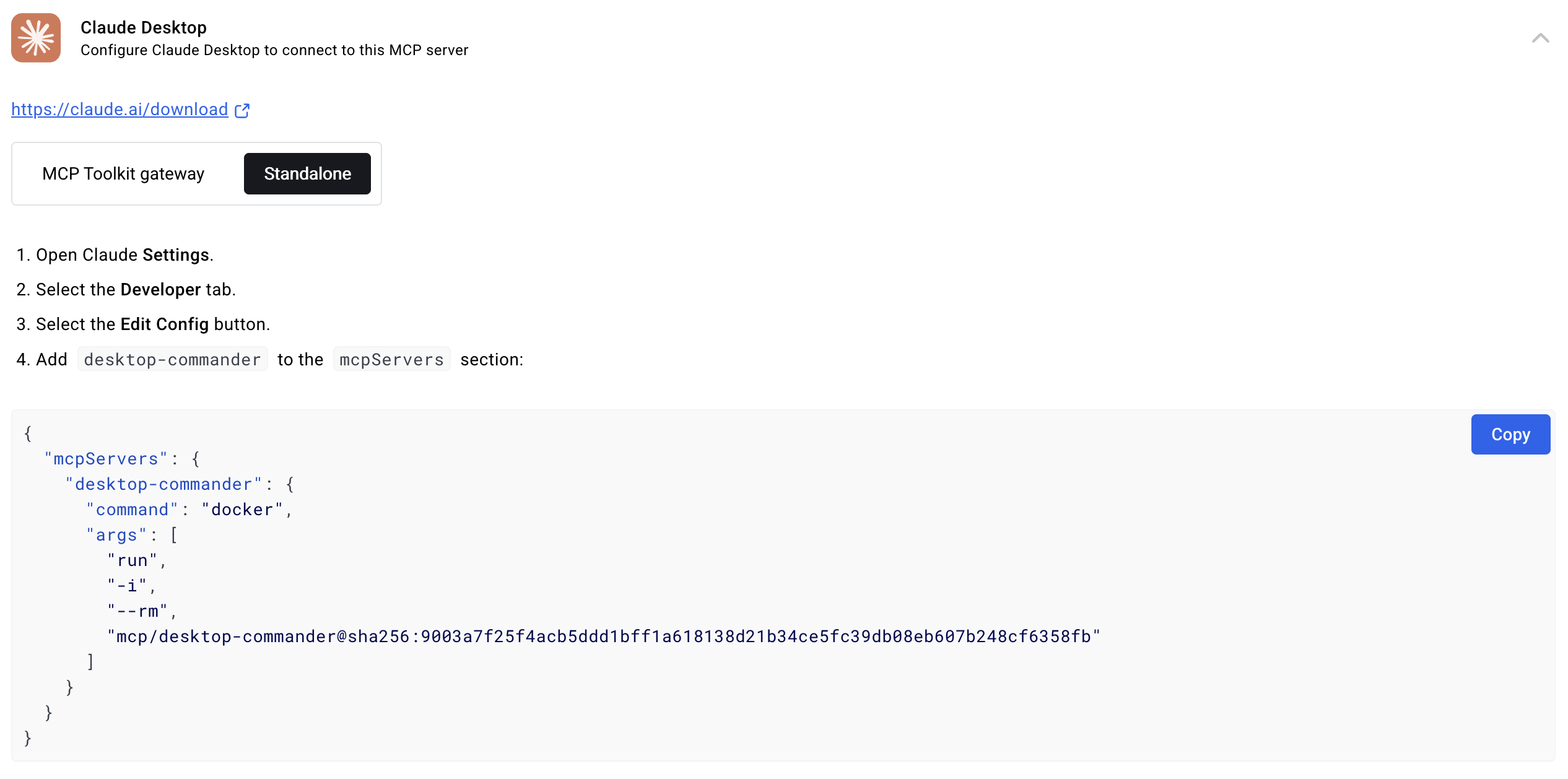
2. Get Desktop Commander Docker Configuration
- Visit: https://hub.docker.com/mcp/server/desktop-commander/manual
- Option A: Use the provided terminal command for automated setup
- Option B: Click "Standalone" to get the config JSON and add it manually to your Claude Desktop config
3. Mount Your Machine Folders (Coming Soon)
- Instructions on how to mount your local directories into the Docker container will be provided soon
- This will allow you to work with your files while maintaining complete isolation
- Complete isolation from your host system
- Consistent environment across different machines
- Easy cleanup - just remove the container when done
- Perfect for testing new features or configurations
Category
Tool
| Category | Tool | Description |
|----------|------|-------------|
| Configuration | get_config | Get the complete server configuration as JSON (includes blockedCommands, defaultShell, allowedDirectories, fileReadLineLimit, fileWriteLineLimit, telemetryEnabled) |
| | set_config_value | Set a specific configuration value by key. Available settings: <br>• blockedCommands: Array of shell commands that cannot be executed<br>• defaultShell: Shell to use for commands (e.g., bash, zsh, powershell)<br>• allowedDirectories: Array of filesystem paths the server can access for file operations (⚠️ terminal commands can still access files outside these directories)<br>• fileReadLineLimit: Maximum lines to read at once (default: 1000)<br>• fileWriteLineLimit: Maximum lines to write at once (default: 50)<br>• telemetryEnabled: Enable/disable telemetry (boolean) |
| Terminal | start_process | Start programs with smart detection of when they're ready for input |
| | interact_with_process | Send commands to running programs and get responses |
| | read_process_output | Read output from running processes |
| | force_terminate | Force terminate a running terminal session |
| | list_sessions | List all active terminal sessions |
| | list_processes | List all running processes with detailed information |
| | kill_process | Terminate a running process by PID |
| Filesystem | read_file | Read contents from local filesystem, URLs, Excel files (.xlsx, .xls, .xlsm), and PDFs with line/page-based pagination |
| | read_multiple_files | Read multiple files simultaneously |
| | write_file | Write file contents with options for rewrite or append mode. Supports Excel files (JSON 2D array format). For PDFs, use write_pdf |
| | write_pdf | Create new PDF files from markdown or modify existing PDFs (insert/delete pages). Supports HTML/CSS styling and SVG graphics |
| | create_directory | Create a new directory or ensure it exists |
| | list_directory | Get detailed recursive listing of files and directories (supports depth parameter, default depth=2) |
| | move_file | Move or rename files and directories |
| | start_search | Start streaming search for files by name or content patterns (searches text files and Excel content) |
| | get_more_search_results | Get paginated results from active search with offset support |
| | stop_search | Stop an active search gracefully |
| | list_searches | List all active search sessions |
| | get_file_info | Retrieve detailed metadata about a file or directory (includes sheet info for Excel files) |
| Text Editing | edit_block | Apply targeted text replacements for text files, or range-based cell updates for Excel files |
| Analytics | get_usage_stats | Get usage statistics for your own insight |
| | get_recent_tool_calls | Get recent tool call history with arguments and outputs for debugging and context recovery |
| | give_feedback_to_desktop_commander | Open feedback form in browser to provide feedback to Desktop Commander Team |
Claude Desktop / Cursor
Paste into your MCP client config file to install this server.
{
    "mcpServers": {
        "desktop commander mcp": {
            "ClaudeDesktopCommander": {
                "command": "npx",
                "args": [
                    "@wonderwhy-er/desktop-commander@latest",
                    "remove"
                ]
            }
        }
    }
}McpServers
{
"ClaudeDesktopCommander": {
"command": "npx",
"args": [
"@wonderwhy-er/desktop-commander@latest",
"remove"
]
}
}Search, update, manage files and run terminal commands with AI



Work with code and text, run processes, and automate tasks, going far beyond other AI editors - while using host client subscriptions instead of API token costs.
<a href="https://glama.ai/mcp/servers/zempur9oh4">
</a>
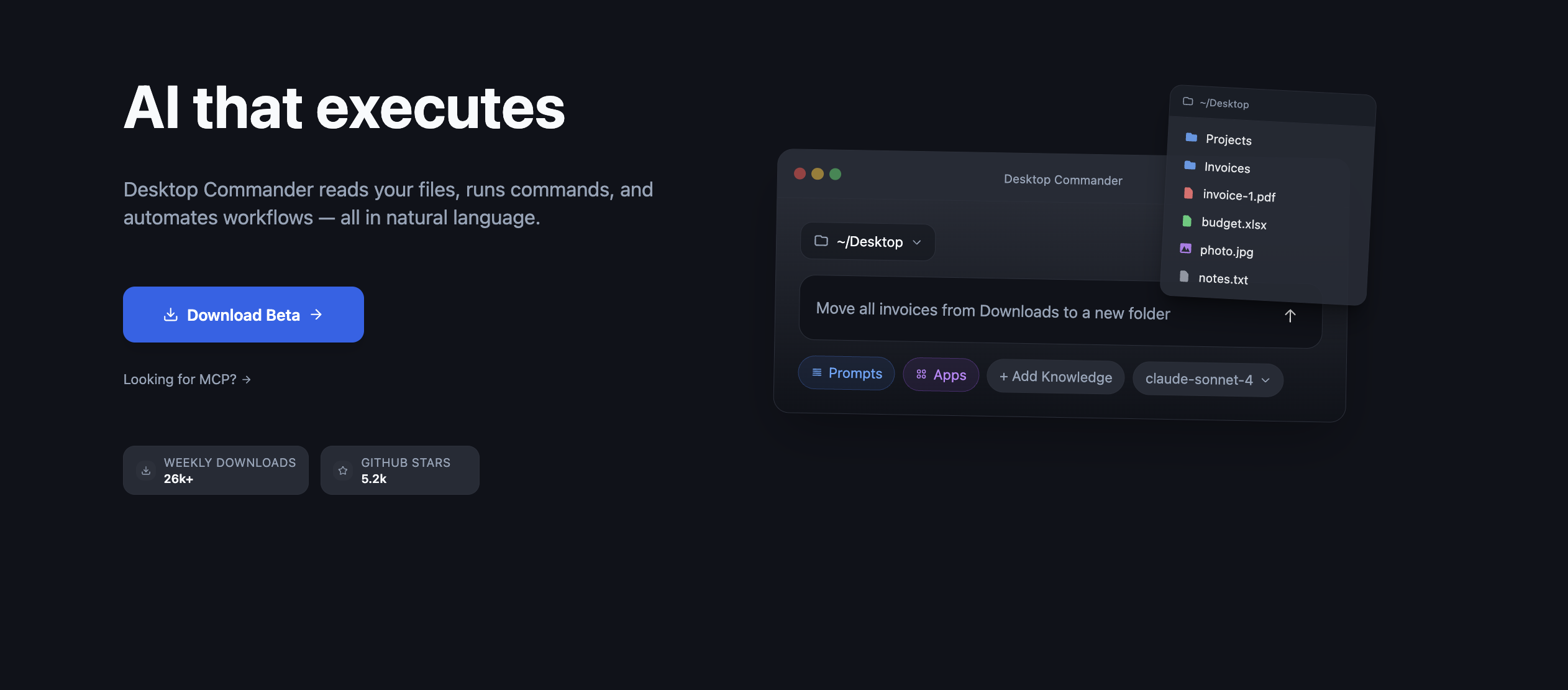
🖥️ Try the Desktop Commander App (Beta)
Want a better experience? The Desktop Commander App gives you everything the MCP server does, plus:
- Use any AI model — Claude, GPT-4.5, Gemini 2.5, or any model you prefer
- See file changes live — visual file previews as AI edits your files
- Add custom MCPs and context — extend with your own tools, no config files
- Coming soon — skills system, dictation, background scheduled tasks, and more
👉 Download the App (macOS & Windows)
> The MCP server below still works great with Claude Desktop and other MCP clients — the app is for those who want a dedicated, polished experience.
Table of Contents
- Features - How to install - Getting Started - Usage - File Preview UI & Markdown Editor - Handling Long-Running Commands - Work in Progress and TODOs - Sponsors and Supporters - Website - Media - Testimonials - Frequently Asked Questions - Contributing - LicenseAll of your AI development tools in one place.
Desktop Commander puts all dev tools in one chat.
Execute long-running terminal commands on your computer and manage processes through Model Context Protocol (MCP). Built on top of MCP Filesystem Server to provide additional search and replace file editing capabilities.
Features
- Remote AI Control - Use Desktop Commander from ChatGPT, Claude web, and other AI services via Remote MCP
- File Preview UI - Visual file previews in Claude Desktop with rendered markdown, inline images, expandable content, built-in markdown editor, and quick "Open in folder" access
- Enhanced terminal commands with interactive process control
- Execute code in memory (Python, Node.js, R) without saving files
- Instant data analysis - just ask to analyze CSV/JSON/Excel files
- Native Excel file support - Read, write, edit, and search Excel files (.xlsx, .xls, .xlsm) without external tools
- PDF support - Read PDFs with text extraction, create new PDFs from markdown, modify existing PDFs
- DOCX support - Read, create, edit, and search Word documents (.docx) with surgical XML editing and markdown-to-DOCX conversion
- Interact with running processes (SSH, databases, development servers)
- Execute terminal commands with output streaming
- Command timeout and background execution support
- Process management (list and kill processes)
- Session management for long-running commands
- Process output pagination - Read terminal output with offset/length controls to prevent context overflow
- Server configuration management:
- Get/set configuration values
- Update multiple settings at once
- Dynamic configuration changes without server restart
- Full filesystem operations:
- Read/write files (text, Excel, PDF, DOCX)
- Create/list directories
- Recursive directory listing with configurable depth and context overflow protection for large folders
- Move files/directories
- Search files and content (including Excel content)
- Get file metadata
- Negative offset file reading: Read from end of files using negative offset values (like Unix tail)
- Code editing capabilities:
- Surgical text replacements for small changes
- Full file rewrites for major changes
- Multiple file support
- Pattern-based replacements
- vscode-ripgrep based recursive code or text search in folders
- Comprehensive audit logging:
- All tool calls are automatically logged
- Log rotation with 10MB size limit
- Detailed timestamps and arguments
- Security hardening:
- Symlink traversal prevention on file operations
- Command blocklist with bypass protection
- Docker isolation for full sandboxing
- See SECURITY.md for details
How to install
Install in Claude Desktop
Desktop Commander offers multiple installation methods for Claude Desktop.
> 📋 Update & Uninstall Information: Options 1, 2, 3, 4, and 6 have automatic updates. Option 5 requires manual updates. See below for details.
<details>
<summary><b>Option 1: Install through npx ⭐ Auto-Updates (Requires Node.js)</b></summary>
Just run this in terminal:
npx @wonderwhy-er/desktop-commander@latest setup
For debugging mode (allows Node.js inspector connection):
npx @wonderwhy-er/desktop-commander@latest setup --debug
Command line options during setup:
- --debug: Enable debugging mode for Node.js inspector
- --no-onboarding: Disable onboarding prompts for new users
Restart Claude if running.
✅ Auto-Updates: Yes - automatically updates when you restart Claude
🔄 Manual Update: Run the setup command again
🗑️ Uninstall: Run npx @wonderwhy-er/desktop-commander@latest remove
</details>
<details>
<summary><b>Option 2: Using bash script installer (macOS) ⭐ Auto-Updates (Installs Node.js if needed)</b></summary>
curl -fsSL https://raw.githubusercontent.com/wonderwhy-er/DesktopCommanderMCP/refs/heads/main/install.sh | bash
✅ Auto-Updates: Yes
🔄 Manual Update: Re-run the bash installer command above
🗑️ Uninstall: Run npx @wonderwhy-er/desktop-commander@latest remove
</details>
<details>
<summary><b>Option 3: Installing via Smithery ⭐ Auto-Updates (Requires Node.js)</b></summary>
1. Visit: https://smithery.ai/server/@wonderwhy-er/desktop-commander
2. Login to Smithery if you haven't already
3. Select your client (Claude Desktop) on the right side
4. Install with the provided key that appears after selecting your client
5. Restart Claude Desktop
✅ Auto-Updates: Yes - automatically updates when you restart Claude
🔄 Manual Update: Visit the Smithery page and reinstall
</details>
<details>
<summary><b>Option 4: Add to claude_desktop_config manually ⭐ Auto-Updates (Requires Node.js)</b></summary>
Add this entry to your claude_desktop_config.json:
- On Mac: ~/Library/Application Support/Claude/claude_desktop_config.json
- On Windows: %APPDATA%\Claude\claude_desktop_config.json
- On Linux: ~/.config/Claude/claude_desktop_config.json
{
  "mcpServers": {
    "desktop-commander": {
      "command": "npx",
      "args": [
        "-y",
        "@wonderwhy-er/desktop-commander@latest"
      ]
    }
  }
}
✅ Auto-Updates: Yes - automatically updates when you restart Claude
🔄 Manual Update: Run the setup command again
🗑️ Uninstall: Run npx @wonderwhy-er/desktop-commander@latest remove or remove the entry from your claude_desktop_config.json
</details>
<details>
<summary><b>Option 5: Checkout locally ❌ Manual Updates (Requires Node.js)</b></summary>
git clone https://github.com/wonderwhy-er/DesktopCommanderMCP.git
cd DesktopCommanderMCP
npm run setup
The setup command will install dependencies, build the server, and configure Claude's desktop app.
❌ Auto-Updates: No - requires manual git updates
🔄 Manual Update: cd DesktopCommanderMCP && git pull && npm run setup
🗑️ Uninstall: Run npx @wonderwhy-er/desktop-commander@latest remove or remove the cloned directory and MCP server entry from Claude config
</details>
<details>
<summary><b>Option 6: Docker Installation 🐳 ⭐ Auto-Updates (No Node.js Required)</b></summary>
Perfect for users who want isolation or don't have Node.js installed. Runs in a sandboxed Docker container with a persistent work environment.
Prerequisites: Docker Desktop installed and running, Claude Desktop app installed.
macOS/Linux:
bash <(curl -fsSL https://raw.githubusercontent.com/wonderwhy-er/DesktopCommanderMCP/refs/heads/main/install-docker.sh)
Windows PowerShell:
iex ((New-Object System.Net.WebClient).DownloadString('https://raw.githubusercontent.com/wonderwhy-er/DesktopCommanderMCP/refs/heads/main/install-docker.ps1'))
The installer will check Docker, pull the image, prompt for folder mounting, and configure Claude Desktop.
Docker persistence: Your tools, configs, work files, and package caches all survive restarts.
<details>
<summary>Manual Docker Configuration</summary>
Basic setup (no file access):
{

  "mcpServers": {

    "desktop-commander-in-docker": {

      "command": "docker",

      "args": ["run", "-i", "--rm", "mcp/desktop-commander:latest"]

    }

  }

}
With folder mounting:
{

  "mcpServers": {

    "desktop-commander-in-docker": {

      "command": "docker",

      "args": [

        "run", "-i", "--rm",

        "-v", "/Users/username/Desktop:/mnt/desktop",

        "-v", "/Users/username/Documents:/mnt/documents",

        "mcp/desktop-commander:latest"

      ]

    }

  }

}
Advanced folder mounting:
{

  "mcpServers": {

    "desktop-commander-in-docker": {

      "command": "docker",

      "args": [

        "run", "-i", "--rm",

        "-v", "dc-system:/usr",

        "-v", "dc-home:/root",

        "-v", "dc-workspace:/workspace",

        "-v", "dc-packages:/var",

        "-v", "/Users/username/Projects:/mnt/Projects",

        "-v", "/Users/username/Downloads:/mnt/Downloads",

        "mcp/desktop-commander:latest"

      ]

    }

  }

}
</details>
<details>
<summary>Docker Management Commands</summary>
macOS/Linux:
```bash
Sign in to leave a review
Use Google, GitHub, or an email account so ratings stay tied to real people.
No reviews posted yet.