GUARDRAIL: Security Framework for Large Language Model Applications
About
GUARDRAIL - MCP Security - Gateway for Unified Access, Resource Delegation, and Risk-Attenuating Information Limits
Details
- Transport
- SSE
- License
- MIT
Explore
- Extensible Security Middleware (ESM) for modular protection
- Dynamic Security Context (DSC) for per-request trust scoring
- Protocol-Level Security Annotations for message classification
- Lightweight Attestation Protocol (LAP) for service verification
- Adaptive Resource Quotas (ARQ) to prevent resource abuse
- Security Event Correlation and Reporting (SECR) for monitoring
Authentication is curiously underdeveloped in GUARDRAIL, which focuses more on attestation between services than user authentication. It lacks:
- Integration patterns with identity providers
- Token validation and management
- Session security
- Authorization frameworks
Reality check: Without solid authentication fundamentals, other security layers become much less effective.
GUARDRAIL can be deployed in several configurations:
1. Embedded Model: GUARDRAIL components are integrated directly into the host process (both client and server). This is suitable for standalone applications or development/testing environments.
2. Gateway Model: GUARDRAIL operates as a standalone security gateway, mediating all MCP traffic. This is ideal for enterprise deployments with strict security requirements.
3. Service Mesh Model: GUARDRAIL components are deployed as sidecars within a Kubernetes environment (or similar). This is best suited for cloud-native and microservices architectures.
flowchart TB
    subgraph "Deployment Models"
        direction LR
subgraph "Embedded Model"

            direction TB

            HC[Host Process]
subgraph "Client Side"

                MCC[MCP Client]

                GC[GUARDRAIL Client Module]
MCC --> GC

            end
subgraph "Server Side"

                MCS[MCP Server]

                GS[GUARDRAIL Server Module]
GS --> MCS

            end
GC <---> GS

        end
subgraph "Gateway Model"

            direction TB

            CL[Client]

            GW[GUARDRAIL Gateway]

            SV[Server]
CL <---> GW

            GW <---> SV

        end
subgraph "Service Mesh Model"

            direction TB
subgraph "Client Pod"

                CP[Client Container]

                CS[GUARDRAIL Sidecar]
CP <---> CS

            end
subgraph "Server Pod"

                SP[Server Container]

                SS[GUARDRAIL Sidecar]
SS <---> SP

            end
subgraph "Control Plane"

                PS[Policy Server]

                IS[Identity Service]

                AS[Audit Collector]

            end
CS <---> SS

            CS <-..-> PS

            CS <-..-> IS

            CS <-..-> AS

            SS <-..-> PS

            SS <-..-> IS

            SS <-..-> AS

        end

    end
get_guardrail_capabilities
Returns the scope and safety boundary of this free, deterministic preflight checker.
assess_action_risk
Runs a deterministic, read-only preflight check. It never executes the proposed action.
GUARDRAIL: Security Framework for Large Language Model Applications
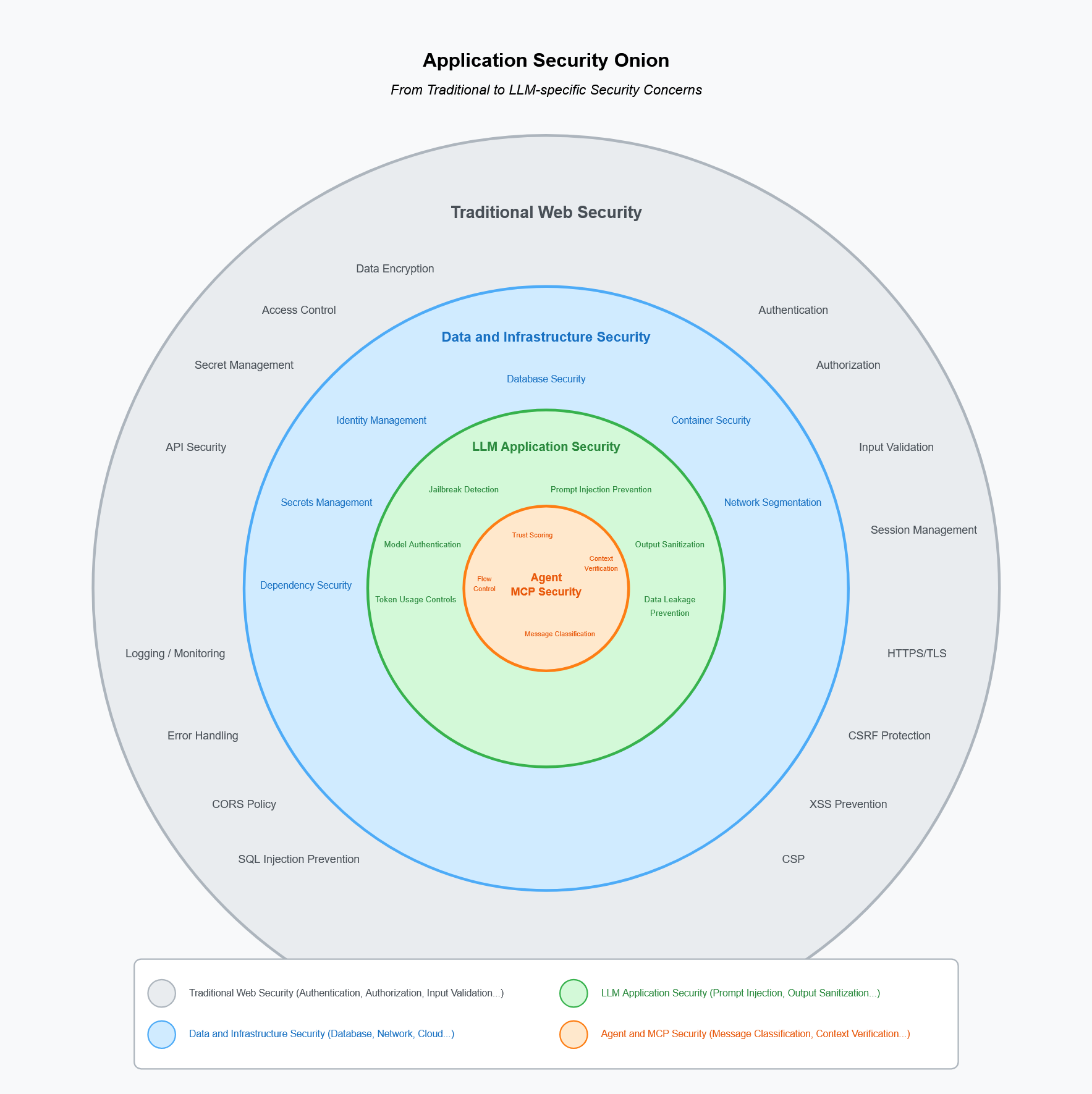
Application Security Onion
Overview
The Application Security Onion diagram visualizes the layered security concerns that modern applications face, with a particular focus on how newer LLM (Large Language Model) and Agent-based systems build upon traditional security foundations.
Understanding the Layers
Like an onion, application security consists of multiple layers that must all be addressed for comprehensive protection:
Layer 1: Traditional Web Security (Outer Layer)
The foundation of all application security, covering fundamental concerns like authentication, authorization, input validation, and transport security. These are well-established practices that remain essential regardless of application type.Layer 2: Data & Infrastructure Security
Building on basic web security, this layer addresses how data is stored, processed, and transported across infrastructure components. This includes database security, container protection, network segmentation, and dependency management.Layer 3: LLM Application Security
Specific security concerns for applications that leverage large language models. This newer domain includes protections against prompt injection, jailbreaking attempts, output sanitization, and preventing data leakage through model interactions.Layer 4: Agent & MCP Security (Core)
At the center are emerging security concerns specific to autonomous agents and the Model Context Protocol (MCP). This includes message classification, context verification, trust scoring, and flow control between agent components.Applications
The Application Security Onion can be used to:
- Assess security coverage across different domains
- Identify gaps in security planning
- Prioritize security initiatives based on foundational requirements
- Educate teams on the relationship between traditional and emerging security concerns
- Create security checklists that ensure all layers are addressed
Implementation Guidance
When approaching application security, work from the outside in:
1. Ensure traditional web security controls are robust and well-implemented
2. Address data and infrastructure security concerns
3. Implement LLM-specific protections as needed
4. Apply agent and MCP-specific security controls at the core
Remember that inner layers depend on outer layers - LLM application security measures will be undermined if traditional web security elements like authentication are weak.
Contributing
This model is evolving as security practices for LLM applications and agents mature. Contributions and suggestions for improving the Application Security Onion are welcome.
---
_The Application Security Onion diagram is licensed under CC BY 4.0. Feel free to share and adapt with attribution._
Practical Security vs. Framework Complexity: The GUARDRAIL Reality Check
1. Isolation vs. Framework Complexity
Simple containerization or VM isolation often provides more immediate security benefits than complex frameworks. While GUARDRAIL offers sophisticated protocol-level security, basic isolation through Docker or VMs:
- Creates clear security boundaries
- Limits potential damage from compromises
- Requires minimal specialized knowledge to implement
- Provides proven protection with lower implementation risk
Reality check: For many teams, proper containerization with resource limits and minimal attack surface would deliver more immediate security value than implementing GUARDRAIL's multi-layered architecture.
2. The Credential Security Gap
The absence of clear credential security patterns in GUARDRAIL is a significant oversight. Basic credential security practices like:
- Secrets management (using tools like HashiCorp Vault or cloud key management)
- Environment variable segregation
- Credential rotation
- Least-privilege access patterns
...aren't explicitly addressed in the framework, despite being fundamental to application security.
Reality check: Storing API keys securely is more immediately valuable than implementing sophisticated protocol-level security annotations.
3. HTTP/SSE Implementation Mismatch
GUARDRAIL's protocol-agnostic approach might seem attractive, but it creates a disconnect from the specific security concerns of HTTP and SSE implementations, including:
- CORS policies
- Content Security Policy
- HTTP header security
- Cross-site scripting protection
- HTTP-specific authentication patterns
Reality check: Framework abstractions that don't connect to your actual transport mechanism (HTTP/SSE) create implementation gaps.
4. The Authentication Blind Spot
Authentication is curiously underdeveloped in GUARDRAIL, which focuses more on attestation between services than user authentication. It lacks:
- Integration patterns with identity providers
- Token validation and management
- Session security
- Authorization frameworks
Reality check: Without solid authentication fundamentals, other security layers become much less effective.
5. The Developer Knowledge Problem
GUARDRAIL doesn't solve the problem of "young devs with no background in app level security." Complex frameworks can actually exacerbate this problem by:
- Creating a false sense of security ("we implemented GUARDRAIL so we're secure")
- Adding complexity that obscures basic security principles
- Requiring specialized knowledge to implement correctly
- Potentially introducing new security gaps through misconfiguration
Reality check: Developer security education and simple, consistent security patterns often yield better outcomes than complex frameworks.
Practical Recommendations
Instead of full GUARDRAIL implementation, consider:
1. Start with basics: Proper isolation, credential management, input validation, and output sanitization
2. Implement LLM-specific controls: Add targeted protections against prompt injection, jailbreaking, and data leakage
3. Use established auth patterns: Leverage battle-tested authentication libraries and frameworks rather than building custom solutions
4. Security education: Invest in developer security awareness specific to LLM applications
5. Selective adoption: If some GUARDRAIL concepts seem valuable (like the Information Gateway Layer), implement them pragmatically without the full framework complexity
Conclusion
GUARDRAIL offers an academically interesting approach to LLM security but may overcomplicate what are often straightforward security challenges. Sometimes basic isolation, handling credentials properly, and following established HTTP security practices will deliver more real security value than implementing complex architectural frameworks.
The gap between security theory and practice remains wide, and addressing fundamental developer security knowledge will likely yield better outcomes than adding architectural complexity through comprehensive frameworks like GUARDRAIL.
Original README:
Executive Summary
GUARDRAIL is a comprehensive security framework designed to protect Large Language Model (LLM) application ecosystems, particularly those built using the Model Context Protocol (MCP). It addresses critical security vulnerabilities inherent in LLM applications, focusing on preventing data exfiltration, data infiltration, unauthorized access, and resource abuse. GUARDRAIL provides a modular, layered, and extensible architecture, offering robust protection without sacrificing performance or usability. It prioritizes practical, incremental adoption, allowing developers to enhance security progressively.
Project Status
…
Sign in to leave a review
Use Google, GitHub, or an email account so ratings stay tied to real people.
No reviews posted yet.