CKG-NVIDIA- AI - Nvidia Developer Stack As A Compressed Knowledge Graph - 20 Domains, 998 Nodes, Agents Traverse Type Dependency Graphs
About
NVIDIA AI developer stack as a Compressed Knowledge Graph (CKG) — 20 domains, 998 nodes, every prerequisite chain declared as typed edges. Agents traverse REQUIRES/ENABLES relationships instead of scanning docs. 4× F1 vs RAG, 11× fewer tokens. No API key required
Details
- Transport
- SSE
Explore
- 4× F1 and 11× fewer tokens vs RAG
- 998 nodes across 20 NVIDIA AI domains
- Deterministic graph traversal – no hallucination
- Read-only: never writes, mutates, or executes
- Typed edges (REQUIRES, ENABLES, RELATES_TO, IMPLEMENTS)
- Three-state confidence (high, null, low) for every edge

Setting up with Highlight
This MCP is not yet compatible with Highlight’s one-click setup. However, you can still use it with Highlight by following these steps:
- Download and install Highlight from highlightai.com/download
- Navigate to the plugins tab and select "Add Custom Plugin"
-
Configure the plugin with the settings below
Plugin Name
CKG-NVIDIA- AI - Nvidia Developer Stack As A Compressed Knowledge Graph - 20 Domains, 998 Nodes, Agents Traverse Type Dependency GraphsCommand (node, npx, python, etc.)Please refer to the README for specific instructions on how to obtain API keys or other required environment variables.
- Enable "Start Automatically" if you want the plugin to start when Highlight launches





From the repository
Install with pip install ckg-nvidia-ai and run the MCP server via uvx ckg-nvidia-ai. Configure it in Claude Desktop, Claude Code, Cursor, or other MCP clients using the provided JSON snippets. Tools include list_domains(), search_concepts(), query_ckg(), get_prerequisites(), and ask_nvidia() (the last requires Ollama with qwen2.5:14b).
list_domains
List all 20 NVIDIA AI domains available in this knowledge graph.
search_concepts
Find concepts in a NVIDIA AI domain by keyword. Args: query: Search term — e.g. 'inference', 'sandbox', 'quantization', 'guardrails'. domain: Domain name from list_domains() — e.g. 'nvidia-nim', 'nvidia-openshell'.
query_ckg
Traverse the NVIDIA knowledge graph from a concept — prerequisites and dependents. Args: concept: Concept name (partial match supported) — e.g. 'TensorRT', 'NIM', 'Isaac Lab'. domain: Domain name from list_domains() — e.g. 'nvidia-tensorrt-triton', 'nvidia-isaac'. depth: Traversal depth 1–5 (default 3).
get_prerequisites
Return the full ordered prerequisite chain for a concept — everything to learn first. Args: concept: Target concept — e.g. 'Speculative Decoding', 'Isaac Lab', 'NeMo Guardrails'. domain: Domain name from list_domains().
ask_nvidia
Ask a natural-language question answered by Qwen grounded on the NVIDIA CKG. Requires Ollama running locally with a Qwen model pulled: ollama pull qwen2.5:14b Override model: NVIDIA_CKG_MODEL env var (default: qwen2.5:14b) Override host: NVIDIA_CKG_OLLAMA env var (default: http://localhost:11434) Args: question: Natural-language question about the NVIDIA AI stack. domain: Domain from list_domains() — auto-detected from question if omitted.
list_ecosystem
Discover other CKG packages for adjacent domains — finance, healthcare, legal, and more.
Claude Desktop / Cursor
Paste into your MCP client config file to install this server.
{
    "mcpServers": {
        "ckg-nvidia- ai - nvidia developer stack as a compressed knowledge graph  - 20 domains, 998 nodes, agents traverse type dependency graphs": {
            "nvidia-ai": {
                "command": "uvx",
                "args": [
                    "ckg-nvidia-ai"
                ]
            }
        }
    }
}McpServers
{
    "nvidia-ai": {
        "command": "uvx",
        "args": [
            "ckg-nvidia-ai"
        ]
    }
}
NVIDIA AI Developer Stack as a Compressed Knowledge Graph
4× F1 · 11× fewer tokens · 998 nodes · deterministic traversal
Instead of scanning docs or re-inferring structure on every query, your agent traverses declared relationships. 20 NVIDIA AI domains, every prerequisite chain typed and ready.
Install:
uvx ckg-nvidia-ai
Example:
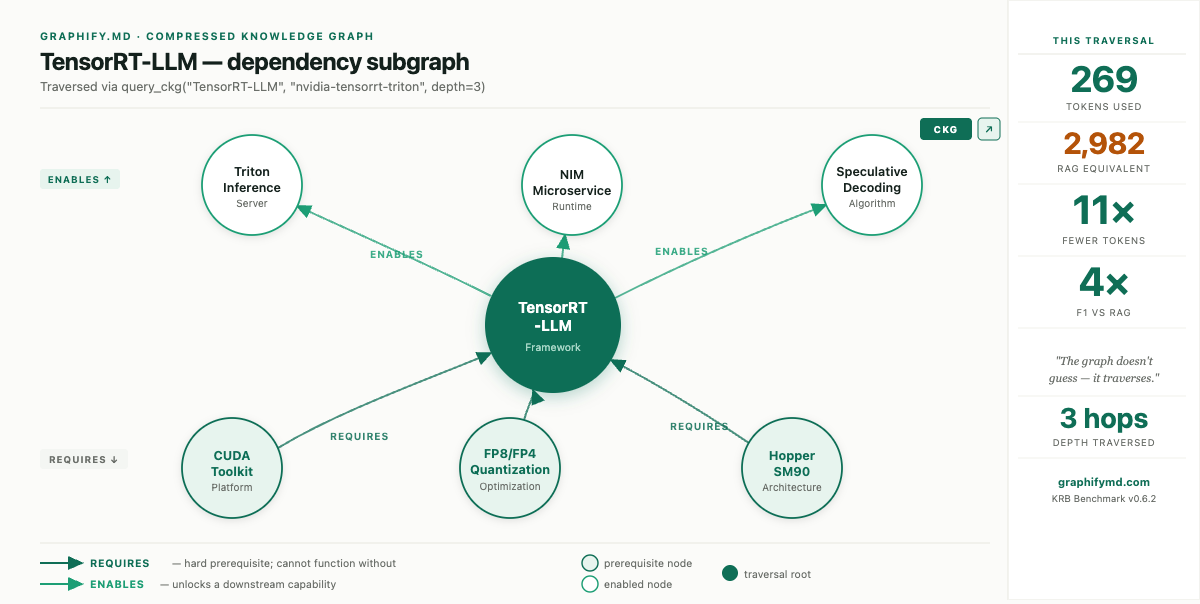
query_ckg("TensorRT-LLM", "nvidia-tensorrt-triton", depth=3)
Returns: CUDA Toolkit, FP8/FP4 Quantization, Hopper SM90 as hard prerequisites. Triton Inference Server and NIM Microservice Runtime as dependents. 269 tokens. No hallucination.
If an edge isn't declared, the traversal returns nothing rather than hallucinating a path. That silence is signal.
Tools: list_domains · query_ckg · get_prerequisites · search_concepts · ask_nvidia (Ollama, no API key)
Domains: NIM · NeMo · TensorRT · CUDA · Isaac · Cosmos · Omniverse · Riva · Jetson · DRIVE · Clara · Metropolis · GameWorks · HPC SDK · CUDA-X · Developer Tools · Graphics Research · AI Enterprise · Developer Ecosystem · OpenShell
Benchmark: CKG F1 0.471 vs RAG 0.123 · 269 tokens vs 2,982 per query
github.com/Yarmoluk/ckg-nvidia-ai
Sign in to leave a review
Use Google, GitHub, or an email account so ratings stay tied to real people.
No reviews posted yet.