Mem0 (Long-Term Memory)
About
Provides persistent long-term memory capabilities through semantic indexing, retrieval, and search functions with support for multiple LLM providers and PostgreSQL vector storage.
Details
- Repository
- coleam00/mcp-mem0
- License
- MIT
Explore
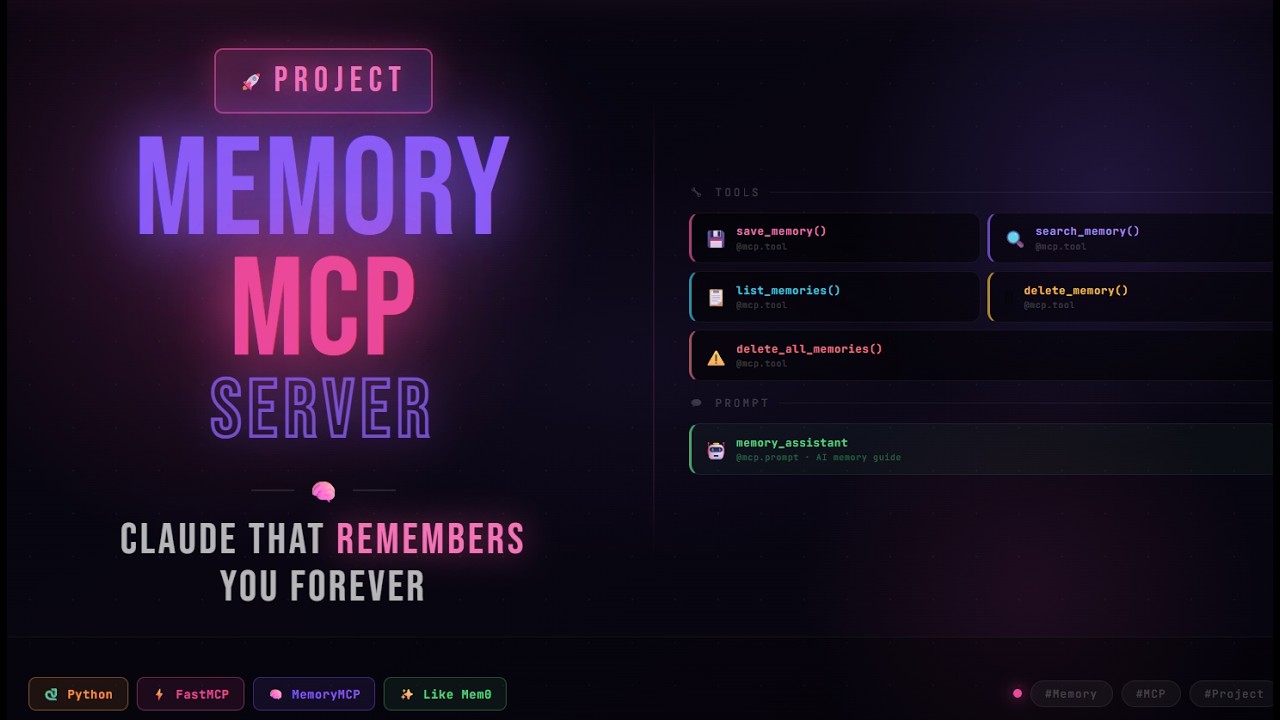
The server provides three essential memory management tools:
1. save_memory: Store any information in long-term memory with semantic indexing
2. get_all_memories: Retrieve all stored memories for comprehensive context
3. search_memories: Find relevant memories using semantic search

Setting up with Highlight
This MCP is not yet compatible with Highlight’s one-click setup. However, you can still use it with Highlight by following these steps:
- Download and install Highlight from highlightai.com/download
- Navigate to the plugins tab and select "Add Custom Plugin"
-
Configure the plugin with the settings below
Plugin Name
Mem0 (Long-Term Memory)Command (node, npx, python, etc.)pythonArguments-
Argument 1
your/path/to/mcp-mem0/src/main.py
Environment-
TRANSPORT
stdio -
LLM_CHOICE
gpt-4o-mini -
LLM_API_KEY
YOUR-API-KEY -
DATABASE_URL
YOUR-DATABASE-URL -
LLM_BASE_URL
https://api.openai.com/v1 -
LLM_PROVIDER
openai -
EMBEDDING_MODEL_CHOICE
text-embedding-3-small
Please refer to the README for specific instructions on how to obtain API keys or other required environment variables.
-
Argument 1
- Enable "Start Automatically" if you want the plugin to start when Highlight launches





From the repository
- Python 3.12+
- Supabase or any PostgreSQL database (for vector storage of memories)
- API keys for your chosen LLM provider (OpenAI, OpenRouter, or Ollama)
- Docker if running the MCP server as a container (recommended)
Once you have the server running with SSE transport, you can connect to it using this configuration:
{
"mcpServers": {
"mem0": {
"transport": "sse",
"url": "http://localhost:8050/sse"
}
}
}
> Note for Windsurf users: Use serverUrl instead of url in your configuration:
>
> {
> "mcpServers": {
> "mem0": {
> "transport": "sse",
> "serverUrl": "http://localhost:8050/sse"
> }
> }
> }
> > Note for n8n users: Use host.docker.internal instead of localhost since n8n has to reach outside of it's own container to the host machine:
>
> So the full URL in the MCP node would be: http://host.docker.internal:8050/sse
Make sure to update the port if you are using a value other than the default 8050.
Add this server to your MCP configuration for Claude Desktop, Windsurf, or any other MCP client:
{
"mcpServers": {
"mem0": {
"command": "your/path/to/mcp-mem0/.venv/Scripts/python.exe",
"args": ["your/path/to/mcp-mem0/src/main.py"],
"env": {
"TRANSPORT": "stdio",
"LLM_PROVIDER": "openai",
"LLM_BASE_URL": "https://api.openai.com/v1",
"LLM_API_KEY": "YOUR-API-KEY",
"LLM_CHOICE": "gpt-4o-mini",
"EMBEDDING_MODEL_CHOICE": "text-embedding-3-small",
"DATABASE_URL": "YOUR-DATABASE-URL"
}
}
}
}
{
"mcpServers": {
"mem0": {
"command": "docker",
"args": ["run", "--rm", "-i",
"-e", "TRANSPORT",
"-e", "LLM_PROVIDER",
"-e", "LLM_BASE_URL",
"-e", "LLM_API_KEY",
"-e", "LLM_CHOICE",
"-e", "EMBEDDING_MODEL_CHOICE",
"-e", "DATABASE_URL",
"mcp/mem0"],
"env": {
"TRANSPORT": "stdio",
"LLM_PROVIDER": "openai",
"LLM_BASE_URL": "https://api.openai.com/v1",
"LLM_API_KEY": "YOUR-API-KEY",
"LLM_CHOICE": "gpt-4o-mini",
"EMBEDDING_MODEL_CHOICE": "text-embedding-3-small",
"DATABASE_URL": "YOUR-DATABASE-URL"
}
}
}
}
save_memory
Store any information in long-term memory with semantic indexing.
get_all_memories
Retrieve all stored memories for comprehensive context.
search_memories
Find relevant memories using semantic search.
Claude Desktop / Cursor
Paste into your MCP client config file to install this server.
{
    "mcpServers": {
        "mem0 (long-term memory)": {
            "env": {
                "TRANSPORT": "stdio",
                "LLM_CHOICE": "gpt-4o-mini",
                "LLM_API_KEY": "YOUR-API-KEY",
                "DATABASE_URL": "YOUR-DATABASE-URL",
                "LLM_BASE_URL": "https://api.openai.com/v1",
                "LLM_PROVIDER": "openai",
                "EMBEDDING_MODEL_CHOICE": "text-embedding-3-small"
            },
            "args": [
                "your/path/to/mcp-mem0/src/main.py"
            ],
            "command": "python"
        }
    }
}Linux
{
"env": {
"TRANSPORT": "stdio",
"LLM_CHOICE": "gpt-4o-mini",
"LLM_API_KEY": "YOUR-API-KEY",
"DATABASE_URL": "YOUR-DATABASE-URL",
"LLM_BASE_URL": "https://api.openai.com/v1",
"LLM_PROVIDER": "openai",
"EMBEDDING_MODEL_CHOICE": "text-embedding-3-small"
},
"args": [
"your/path/to/mcp-mem0/src/main.py"
],
"command": "python"
}Macos
{
"env": {
"TRANSPORT": "stdio",
"LLM_CHOICE": "gpt-4o-mini",
"LLM_API_KEY": "YOUR-API-KEY",
"DATABASE_URL": "YOUR-DATABASE-URL",
"LLM_BASE_URL": "https://api.openai.com/v1",
"LLM_PROVIDER": "openai",
"EMBEDDING_MODEL_CHOICE": "text-embedding-3-small"
},
"args": [
"your/path/to/mcp-mem0/src/main.py"
],
"command": "python"
}Windows
{
"env": {
"TRANSPORT": "stdio",
"LLM_CHOICE": "gpt-4o-mini",
"LLM_API_KEY": "YOUR-API-KEY",
"DATABASE_URL": "YOUR-DATABASE-URL",
"LLM_BASE_URL": "https://api.openai.com/v1",
"LLM_PROVIDER": "openai",
"EMBEDDING_MODEL_CHOICE": "text-embedding-3-small"
},
"args": [
"/c",
"your/path/to/mcp-mem0/.venv/Scripts/python.exe",
"your/path/to/mcp-mem0/src/main.py"
],
"command": "cmd"
}<h1 align="center">MCP-Mem0: Long-Term Memory for AI Agents</h1>
<p align="center">

</p>
A template implementation of the Model Context Protocol (MCP) server integrated with Mem0 for providing AI agents with persistent memory capabilities.
Use this as a reference point to build your MCP servers yourself, or give this as an example to an AI coding assistant and tell it to follow this example for structure and code correctness!
Overview
This project demonstrates how to build an MCP server that enables AI agents to store, retrieve, and search memories using semantic search. It serves as a practical template for creating your own MCP servers, simply using Mem0 and a practical example.
The implementation follows the best practices laid out by Anthropic for building MCP servers, allowing seamless integration with any MCP-compatible client.
Features
The server provides three essential memory management tools:
1. save_memory: Store any information in long-term memory with semantic indexing
2. get_all_memories: Retrieve all stored memories for comprehensive context
3. search_memories: Find relevant memories using semantic search
Prerequisites
- Python 3.12+
- Supabase or any PostgreSQL database (for vector storage of memories)
- API keys for your chosen LLM provider (OpenAI, OpenRouter, or Ollama)
- Docker if running the MCP server as a container (recommended)
Installation
Using uv
1. Install uv if you don't have it:
pip install uv
2. Clone this repository:
git clone https://github.com/coleam00/mcp-mem0.git
cd mcp-mem0
3. Install dependencies:
uv pip install -e .
4. Create a .env file based on .env.example:
cp .env.example .env
5. Configure your environment variables in the .env file (see Configuration section)
Using Docker (Recommended)
1. Build the Docker image:
docker build -t mcp/mem0 --build-arg PORT=8050 .
2. Create a .env file based on .env.example and configure your environment variables
Configuration
The following environment variables can be configured in your .env file:
| Variable | Description | Example |
|----------|-------------|----------|
| TRANSPORT | Transport protocol (sse or stdio) | sse |
| HOST | Host to bind to when using SSE transport | 0.0.0.0 |
| PORT | Port to listen on when using SSE transport | 8050 |
| LLM_PROVIDER | LLM provider (openai, openrouter, or ollama) | openai |
| LLM_BASE_URL | Base URL for the LLM API | https://api.openai.com/v1 |
| LLM_API_KEY | API key for the LLM provider | sk-... |
| LLM_CHOICE | LLM model to use | gpt-4o-mini |
| EMBEDDING_MODEL_CHOICE | Embedding model to use | text-embedding-3-small |
| DATABASE_URL | PostgreSQL connection string | postgresql://user:pass@host:port/db |
Running the Server
Using uv
SSE Transport
# Set TRANSPORT=sse in .env then:
uv run src/main.py
The MCP server will essentially be run as an API endpoint that you can then connect to with config shown below.
Stdio Transport
With stdio, the MCP client iself can spin up the MCP server, so nothing to run at this point.
Using Docker
SSE Transport
docker run --env-file .env -p:8050:8050 mcp/mem0
The MCP server will essentially be run as an API endpoint within the container that you can then connect to with config shown below.
Stdio Transport
With stdio, the MCP client iself can spin up the MCP server container, so nothing to run at this point.
Integration with MCP Clients
SSE Configuration
Once you have the server running with SSE transport, you can connect to it using this configuration:
{
  "mcpServers": {
    "mem0": {
      "transport": "sse",
      "url": "http://localhost:8050/sse"
    }
  }
}
> Note for Windsurf users: Use serverUrl instead of url in your configuration:
>
> {

>   "mcpServers": {

>     "mem0": {

>       "transport": "sse",

>       "serverUrl": "http://localhost:8050/sse"

>     }

>   }

> }

>
> Note for n8n users: Use host.docker.internal instead of localhost since n8n has to reach outside of it's own container to the host machine:
>
> So the full URL in the MCP node would be: http://host.docker.internal:8050/sse
Make sure to update the port if you are using a value other than the default 8050.
Python with Stdio Configuration
Add this server to your MCP configuration for Claude Desktop, Windsurf, or any other MCP client:
{
  "mcpServers": {
    "mem0": {
      "command": "your/path/to/mcp-mem0/.venv/Scripts/python.exe",
      "args": ["your/path/to/mcp-mem0/src/main.py"],
      "env": {
        "TRANSPORT": "stdio",
        "LLM_PROVIDER": "openai",
        "LLM_BASE_URL": "https://api.openai.com/v1",
        "LLM_API_KEY": "YOUR-API-KEY",
        "LLM_CHOICE": "gpt-4o-mini",
        "EMBEDDING_MODEL_CHOICE": "text-embedding-3-small",
        "DATABASE_URL": "YOUR-DATABASE-URL"
      }
    }
  }
}
Docker with Stdio Configuration
{
  "mcpServers": {
    "mem0": {
      "command": "docker",
      "args": ["run", "--rm", "-i",
               "-e", "TRANSPORT",
               "-e", "LLM_PROVIDER",
               "-e", "LLM_BASE_URL",
               "-e", "LLM_API_KEY",
               "-e", "LLM_CHOICE",
               "-e", "EMBEDDING_MODEL_CHOICE",
               "-e", "DATABASE_URL",
               "mcp/mem0"],
      "env": {
        "TRANSPORT": "stdio",
        "LLM_PROVIDER": "openai",
        "LLM_BASE_URL": "https://api.openai.com/v1",
        "LLM_API_KEY": "YOUR-API-KEY",
        "LLM_CHOICE": "gpt-4o-mini",
        "EMBEDDING_MODEL_CHOICE": "text-embedding-3-small",
        "DATABASE_URL": "YOUR-DATABASE-URL"
      }
    }
  }
}
Building Your Own Server
This template provides a foundation for building more complex MCP servers. To build your own:
1. Add your own tools by creating methods with the @mcp.tool() decorator
2. Create your own lifespan function to add your own dependencies (clients, database connections, etc.)
3. Modify the utils.py file for any helper functions you need for your MCP server
4. Feel free to add prompts and resources as well with @mcp.resource() and @mcp.prompt()
Sign in to leave a review
Use Google, GitHub, or an email account so ratings stay tied to real people.
No reviews posted yet.