deBridge
About
Official deBridge protocol MCP Server. Finds optimal cross-chain swap routes, checks fees and conditions, initiates trades across major blockchain networks
Details
- Transport
- SSE
- License
- MIT
Explore
- Cross-chain and same-chain swap execution.
- Fee estimation before trade execution.
- Hosted MCP endpoint with Streamable HTTP transport.
- Local proxy for stdio-only agent frameworks.
- Tools: search_tokens, get_supported_chains, create_tx, and more.
- Workflow skills via MCP resources and llms.txt overview.

Setting up with Highlight
This MCP is not yet compatible with Highlight’s one-click setup. However, you can still use it with Highlight by following these steps:
- Download and install Highlight from highlightai.com/download
- Navigate to the plugins tab and select "Add Custom Plugin"
-
Configure the plugin with the settings below
Plugin Name
deBridgeCommand (node, npx, python, etc.)Please refer to the README for specific instructions on how to obtain API keys or other required environment variables.
- Enable "Start Automatically" if you want the plugin to start when Highlight launches





From the repository
| Variable | Default | Description |
|----------|---------|-------------|
| REMOTE_MCP_URL | https://agents.debridge.com/mcp | Remote MCP endpoint to proxy to |
| MCP_TRANSPORT | stdio | Transport mode: stdio or http |
| PORT | 3000 | HTTP listen port (HTTP mode only) |
| HOST | 0.0.0.0 | HTTP listen host (HTTP mode only) |
npm install
get_instructions
Returns the full guide for the deBridge MCP server. CALL THIS FIRST.
search_tokens
Search for tokens by name, symbol, or contract address in the deBridge token database
get_supported_chains
List all blockchain networks supported by deBridge for cross-chain swaps
create_tx
Create a cross-chain swap transaction via the deBridge DLN protocol
transaction_same_chain_swap
Create a same-chain token swap transaction via deBridge
Claude Desktop / Cursor
Paste into your MCP client config file to install this server.
{
    "mcpServers": {
        "debridge": {
            "deBridge": {
                "command": "npx",
                "args": [
                    "@debridge-finance/debridge-mcp@latest"
                ]
            }
        }
    }
}McpServers
{
    "deBridge": {
        "command": "npx",
        "args": [
            "@debridge-finance/debridge-mcp@latest"
        ]
    }
}








deBridge MCP integration for AI agents — cross-chain and same-chain swaps, fee estimation, and trade execution across major blockchain networks.
The hosted MCP endpoint is available at agents.debridge.com. This npm package is a thin proxy client for agents that require a local stdio or HTTP process.
https://github.com/user-attachments/assets/8ebe88ff-db3c-455e-9efb-50389e4bf5bd
Connecting to deBridge MCP
Recommended: Direct connection (Streamable HTTP)
Connect your agent directly to the hosted endpoint — no installation, no local process:
https://agents.debridge.com/mcp
This is a Streamable HTTP MCP endpoint. It exposes tools (get_instructions, search_tokens, get_supported_chains, create_tx, transaction_same_chain_swap), workflow skills via MCP resources, and an llms.txt overview. Tools and skills are maintained in the debridge-finance/debridge-skills repository.
Generic Streamable HTTP configuration:
"debridge": {
  "type": "streamable-http",
  "url": "https://agents.debridge.com/mcp"
}
<details>
<summary>Claude Code (CLI & IDE plugins)</summary>
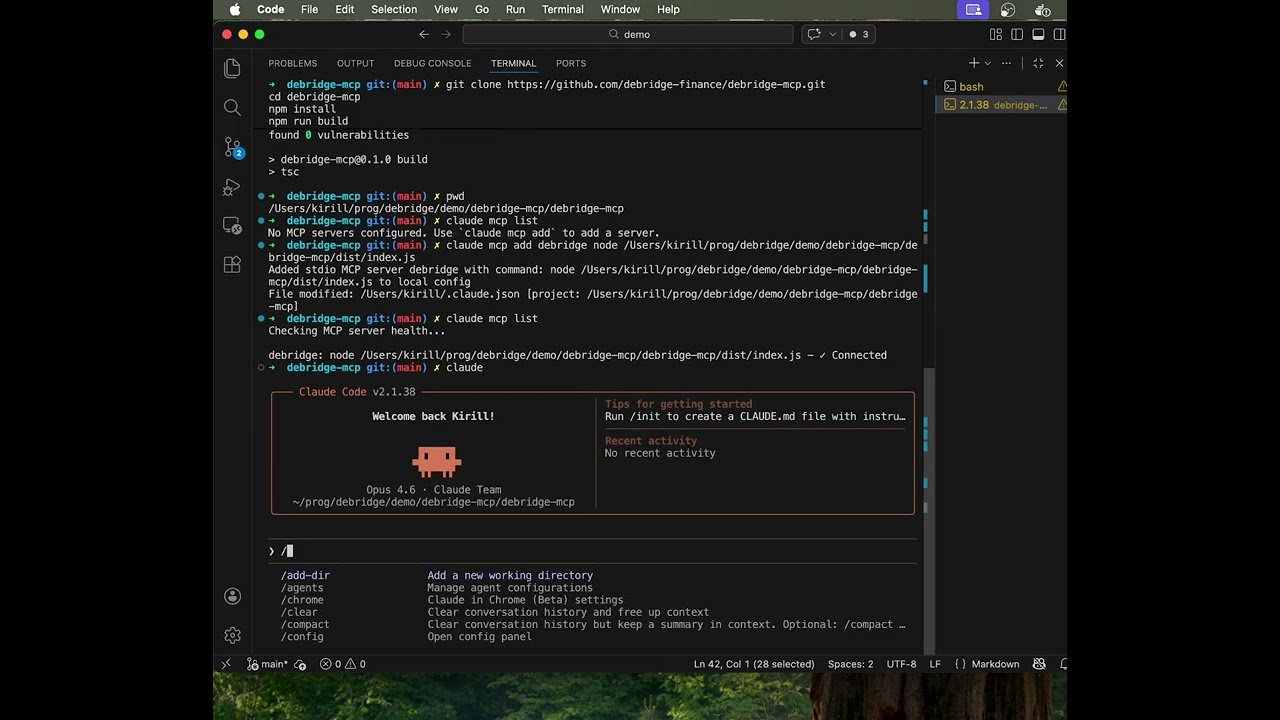
claude mcp add debridge --transport http https://agents.debridge.com/mcp
Verify:
claude mcp list
</details>
<details>
<summary>Claude Web & Desktop Apps</summary>
Add as a remote MCP server with the URL https://agents.debridge.com/mcp.
</details>
<details>
<summary>Cursor</summary>
Add to .cursor/mcp.json in your project or ~/.cursor/mcp.json globally:
{
  "mcpServers": {
    "debridge": {
      "url": "https://agents.debridge.com/mcp"
    }
  }
}
</details>
<details>
<summary>GitHub Copilot (VS Code Chat)</summary>
Add to .vscode/mcp.json in your workspace:
{
  "mcpServers": {
    "debridge": {
      "type": "streamable-http",
      "url": "https://agents.debridge.com/mcp"
    }
  }
}
</details>
<details>
<summary>Windsurf</summary>
Add to ~/.codeium/windsurf/mcp_config.json:
{
  "mcpServers": {
    "debridge": {
      "type": "streamable-http",
      "url": "https://agents.debridge.com/mcp"
    }
  }
}
</details>
<details>
<summary>Cline</summary>
Open Cline settings in VS Code, go to MCP Servers, click "Edit MCP Settings" and add:
{
  "mcpServers": {
    "debridge": {
      "type": "streamable-http",
      "url": "https://agents.debridge.com/mcp"
    }
  }
}
</details>
<details>
<summary>Continue</summary>
Add to ~/.continue/config.json:
{
  "mcpServers": [
    {
      "name": "debridge",
      "transport": "streamable-http",
      "url": "https://agents.debridge.com/mcp"
    }
  ]
}
</details>
<details>
<summary>Zed</summary>
Add to your Zed settings (~/.config/zed/settings.json):
{
  "context_servers": {
    "debridge": {
      "transport": "streamable-http",
      "url": "https://agents.debridge.com/mcp"
    }
  }
}
</details>
<details>
<summary>OpenClaw (via mcp-adapter plugin)</summary>
Install the mcp-adapter plugin:
openclaw plugins install mcp-adapter
Add to ~/.openclaw/openclaw.json:
{

  "plugins": {

    "entries": {

      "mcp-adapter": {

        "enabled": true,

        "config": {

          "servers": [

            {

              "name": "debridge",

              "transport": "streamable-http",

              "url": "https://agents.debridge.com/mcp"

            }

          ]

        }

      }

    }

  }

}
</details>
---
Alternative: Run a local proxy
Some agent frameworks only support stdio transport and cannot connect to a remote HTTP endpoint directly. This npm package bridges that gap — it runs a local MCP process that transparently proxies all requests to https://agents.debridge.com/mcp.
Tools and resources are not implemented locally. They are dynamically discovered from the upstream endpoint at startup (stdio) or forwarded per-request (HTTP), so any changes to the hosted MCPd are reflected automatically without updating the package.
How the proxy works
- Stdio mode (default): Opens a long-lived MCP client connection to the upstream MCPd via StreamableHTTPClientTransport. Creates a local Server with StdioServerTransport that mirrors the upstream capabilities and forwards tools/list, tools/call, resources/list, resources/read, and resources/templates/list to the upstream.
- HTTP mode (MCP_TRANSPORT=http): Transparent HTTP reverse proxy via Express. Forwards raw JSON-RPC requests and SSE response streams to the upstream MCPd, passing through Mcp-Session-Id headers for session continuity.
npx (stdio)
npx -y @debridge-finance/debridge-mcp@latest
stdio configuration:
"debridge": {
  "type": "stdio",
  "command": "npx",
  "args": ["-y", "@debridge-finance/debridge-mcp@latest"]
}
<details>
<summary>Claude Code (CLI & IDE plugins)</summary>
claude mcp add debridge npx -- -y @debridge-finance/debridge-mcp@latest
</details>
<details>
<summary>Cursor</summary>
Use Cursor Deeplink: 
OR install from Cursor Directory
OR add to .cursor/mcp.json:
{
  "mcpServers": {
    "debridge": {
      "command": "npx",
      "args": ["-y", "@debridge-finance/debridge-mcp@latest"]
    }
  }
}
</details>
Docker (HTTP proxy)
docker build -t debridge-mcp .
docker run -p 3000:3000 debridge-mcp
Then connect your agent to http://localhost:3000/mcp using the Streamable HTTP configs above.
Environment Variables
| Variable | Default | Description |
|----------|---------|-------------|
| REMOTE_MCP_URL | https://agents.debridge.com/mcp | Remote MCP endpoint to proxy to |
| MCP_TRANSPORT | stdio | Transport mode: stdio or http |
| PORT | 3000 | HTTP listen port (HTTP mode only) |
| HOST | 0.0.0.0 | HTTP listen host (HTTP mode only) |
Development
```bash
Sign in to leave a review
Use Google, GitHub, or an email account so ratings stay tied to real people.
No reviews posted yet.