
Kubernetes MCP Server
About
A versatile MCP server for Kubernetes and OpenShift, distributed as a native binary, npm/Python package, or Docker image.
Explore
A powerful and flexible Kubernetes Model Context Protocol (MCP) server implementation with support for Kubernetes and OpenShift.
- ✅ Configuration:
- Automatically detect changes in the Kubernetes configuration and update the MCP server.
- View and manage the current Kubernetes .kube/config or in-cluster configuration.
- ✅ Generic Kubernetes Resources: Perform operations on any Kubernetes or OpenShift resource.
- Any CRUD operation (Create or Update, Get, List, Delete).
- ✅ Pods: Perform Pod-specific operations.
- List pods in all namespaces or in a specific namespace.
- Get a pod by name from the specified namespace.
- Delete a pod by name from the specified namespace.
- Show logs for a pod by name from the specified namespace.
- Top gets resource usage metrics for all pods or a specific pod in the specified namespace.
- Exec into a pod and run a command.
- Run a container image in a pod and optionally expose it.
- ✅ Namespaces: List Kubernetes Namespaces.
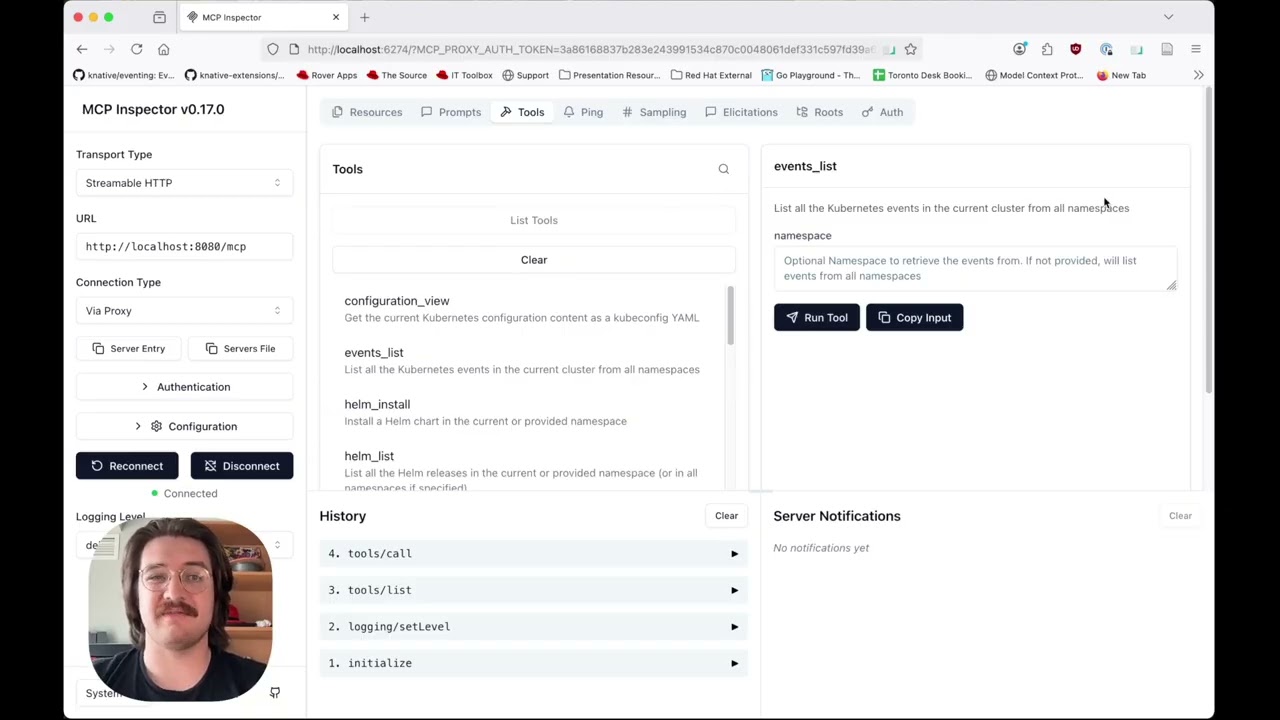
- ✅ Events: View Kubernetes events in all namespaces or in a specific namespace.
- ✅ Projects: List OpenShift Projects.
- ☸️ Helm:
- Install a Helm chart in the current or provided namespace.
- List Helm releases in all namespaces or in a specific namespace.
- Uninstall a Helm release in the current or provided namespace.
- 🔧 Tekton: Tekton-specific operations that complement generic Kubernetes resource management.
- Pipeline: Start a Tekton Pipeline by creating a PipelineRun.
- PipelineRun: Restart a PipelineRun with the same spec.
- Task: Start a Tekton Task by creating a TaskRun.
- TaskRun: Restart a TaskRun with the same spec, and retrieve TaskRun logs via pod resolution.
- 🔭 Observability: Optional OpenTelemetry distributed tracing and metrics with custom sampling rates. Includes /stats endpoint for real-time statistics. See OTEL.md.
Unlike other Kubernetes MCP server implementations, this IS NOT just a wrapper around kubectl or helm command-line tools.
It is a Go-based native implementation that interacts directly with the Kubernetes API server.
There is NO NEED for external dependencies or tools to be installed on the system.
If you're using the native binaries you don't need to have Node or Python installed on your system.
- ✅ Lightweight: The server is distributed as a single native binary for Linux, macOS, and Windows.
- ✅ High-Performance / Low-Latency: Directly interacts with the Kubernetes API server without the overhead of calling and waiting for external commands.
- ✅ Multi-Cluster: Can interact with multiple Kubernetes clusters simultaneously (as defined in your kubeconfig files).
- ✅ Cross-Platform: Available as a native binary for Linux, macOS, and Windows, as well as an npm package, a Python package, and container/Docker image.
- ✅ Configurable: Supports command-line arguments, TOML configuration files, and environment variables.
- ✅ Well tested: The server has an extensive test suite to ensure its reliability and correctness across different Kubernetes environments.
- 📚 Documentation: Comprehensive user documentation including setup guides, configuration reference, and observability.

Setting up with Highlight
This MCP is not yet compatible with Highlight’s one-click setup. However, you can still use it with Highlight by following these steps:
- Download and install Highlight from highlightai.com/download
- Navigate to the plugins tab and select "Add Custom Plugin"
-
Configure the plugin with the settings below
Plugin Name
Kubernetes MCP ServerCommand (node, npx, python, etc.)Please refer to the README for specific instructions on how to obtain API keys or other required environment variables.
- Enable "Start Automatically" if you want the plugin to start when Highlight launches





From the repository
🚀 Getting Started <a id="getting-started"></a>
Requirements
- Access to a Kubernetes cluster.
<details>
<summary><b>Claude Code</b></summary>
Follow the dedicated Claude Code getting started guide in our user documentation.
For a secure production setup with dedicated ServiceAccount and read-only access, also review the Kubernetes setup guide.
</details>
Toolset
Description
config
View and manage the current local Kubernetes configuration (kubeconfig)
core
Most common tools for Kubernetes management (Pods, Generic Resources, Events, etc.)
helm
Tools for managing Helm charts and releases
kcp
Manage kcp workspaces and multi-tenancy features
kiali
Most common tools for managing Kiali, check the [Kiali documentation](https://github.com/containers/kubernetes-mcp-server/blob/main/docs/KIALI.md) for more details.
kubevirt
KubeVirt virtual machine management tools, check the [KubeVirt documentation](https://github.com/containers/kubernetes-mcp-server/blob/main/docs/kubevirt.md) for more details.
tekton
Tekton pipeline management tools for Pipelines, PipelineRuns, Tasks, and TaskRuns.
The following sets of tools are available (toolsets marked with ✓ in the Default column are enabled by default):
<!-- AVAILABLE-TOOLSETS-START -->
| Toolset | Description | Default |
|----------|---------------------------------------------------------------------------------------------------------------------------------------------------------------------------------|---------|
| config | View and manage the current local Kubernetes configuration (kubeconfig) | ✓ |
| core | Most common tools for Kubernetes management (Pods, Generic Resources, Events, etc.) | ✓ |
| helm | Tools for managing Helm charts and releases | |
| kcp | Manage kcp workspaces and multi-tenancy features | |
| kiali | Most common tools for managing Kiali, check the Kiali documentation for more details. | |
| kubevirt | KubeVirt virtual machine management tools, check the KubeVirt documentation for more details. | |
| tekton | Tekton pipeline management tools for Pipelines, PipelineRuns, Tasks, and TaskRuns. | |
<!-- AVAILABLE-TOOLSETS-END -->
Claude Desktop / Cursor
Paste into your MCP client config file to install this server.
{
    "mcpServers": {
        "kubernetes mcp server": {
            "kubernetes-mcp-server": {
                "command": "npx",
                "args": [
                    "kubernetes-mcp-server@latest",
                    "--help"
                ]
            }
        }
    }
}McpServers
{
    "kubernetes-mcp-server": {
        "command": "npx",
        "args": [
            "kubernetes-mcp-server@latest",
            "--help"
        ]
    }
}





✨ Features | 🚀 Getting Started | 🎥 Demos | ⚙️ Configuration | 🛠️ Tools | 💬 Community | 🧑💻 Development
https://github.com/user-attachments/assets/be2b67b3-fc1c-4d11-ae46-93deba8ed98e
✨ Features <a id="features"></a>
A powerful and flexible Kubernetes Model Context Protocol (MCP) server implementation with support for Kubernetes and OpenShift.
- ✅ Configuration:
- Automatically detect changes in the Kubernetes configuration and update the MCP server.
- View and manage the current Kubernetes .kube/config or in-cluster configuration.
- ✅ Generic Kubernetes Resources: Perform operations on any Kubernetes or OpenShift resource.
- Any CRUD operation (Create or Update, Get, List, Delete).
- ✅ Pods: Perform Pod-specific operations.
- List pods in all namespaces or in a specific namespace.
- Get a pod by name from the specified namespace.
- Delete a pod by name from the specified namespace.
- Show logs for a pod by name from the specified namespace.
- Top gets resource usage metrics for all pods or a specific pod in the specified namespace.
- Exec into a pod and run a command.
- Run a container image in a pod and optionally expose it.
- ✅ Namespaces: List Kubernetes Namespaces.
- ✅ Events: View Kubernetes events in all namespaces or in a specific namespace.
- ✅ Projects: List OpenShift Projects.
- ☸️ Helm:
- Install a Helm chart in the current or provided namespace.
- List Helm releases in all namespaces or in a specific namespace.
- Uninstall a Helm release in the current or provided namespace.
- 🔧 Tekton: Tekton-specific operations that complement generic Kubernetes resource management.
- Pipeline: Start a Tekton Pipeline by creating a PipelineRun.
- PipelineRun: Restart a PipelineRun with the same spec.
- Task: Start a Tekton Task by creating a TaskRun.
- TaskRun: Restart a TaskRun with the same spec, and retrieve TaskRun logs via pod resolution.
- 🔭 Observability: Optional OpenTelemetry distributed tracing and metrics with custom sampling rates. Includes /stats endpoint for real-time statistics. See OTEL.md.
Unlike other Kubernetes MCP server implementations, this IS NOT just a wrapper around kubectl or helm command-line tools.
It is a Go-based native implementation that interacts directly with the Kubernetes API server.
There is NO NEED for external dependencies or tools to be installed on the system.
If you're using the native binaries you don't need to have Node or Python installed on your system.
- ✅ Lightweight: The server is distributed as a single native binary for Linux, macOS, and Windows.
- ✅ High-Performance / Low-Latency: Directly interacts with the Kubernetes API server without the overhead of calling and waiting for external commands.
- ✅ Multi-Cluster: Can interact with multiple Kubernetes clusters simultaneously (as defined in your kubeconfig files).
- ✅ Cross-Platform: Available as a native binary for Linux, macOS, and Windows, as well as an npm package, a Python package, and container/Docker image.
- ✅ Configurable: Supports command-line arguments, TOML configuration files, and environment variables.
- ✅ Well tested: The server has an extensive test suite to ensure its reliability and correctness across different Kubernetes environments.
- 📚 Documentation: Comprehensive user documentation including setup guides, configuration reference, and observability.
🚀 Getting Started <a id="getting-started"></a>
Requirements
- Access to a Kubernetes cluster.
<details>
<summary><b>Claude Code</b></summary>
Follow the dedicated Claude Code getting started guide in our user documentation.
For a secure production setup with dedicated ServiceAccount and read-only access, also review the Kubernetes setup guide.
</details>
Claude Desktop
Using npx
If you have npm installed, this is the fastest way to get started with kubernetes-mcp-server on Claude Desktop.
Open your claude_desktop_config.json and add the mcp server to the list of mcpServers:
{
  "mcpServers": {
    "kubernetes": {
      "command": "npx",
      "args": ["-y", "kubernetes-mcp-server@latest"]
    }
  }
}
VS Code / VS Code Insiders
Install the Kubernetes MCP server extension in VS Code Insiders by pressing the following link:


Alternatively, you can install the extension manually by running the following command:
```shell
Sign in to leave a review
Use Google, GitHub, or an email account so ratings stay tied to real people.
No reviews posted yet.