Mcp Broker
About
mcp-broker is a local Model Context Protocol process broker for MCP clients. Think PgBouncer for MCP: one stable local endpoint in front of many upstream MCP servers. The broker owns upstream startup, reuse, cleanup, profile exposure, status, and safe tool routing. The core idea is simple: do not make every agent…
Explore
- Runs one local broker daemon over a Unix socket.
- Starts upstream MCP servers on demand and reuses shared upstreams across sessions.
- Maps upstream tools into stable namespaces exposed via compact broker facade tools.
- Enforces profile-level tool budgets and exposure gates.
- Blocks mutating upstream exposure unless a profile allowlist grants it.
- Provides cross-platform daemon management: LaunchAgent, systemd, and Windows Scheduled Task.
- Includes dry‑run, backup, and rollback for client config rendering.

Setting up with Highlight
This MCP is not yet compatible with Highlight’s one-click setup. However, you can still use it with Highlight by following these steps:
- Download and install Highlight from highlightai.com/download
- Navigate to the plugins tab and select "Add Custom Plugin"
-
Configure the plugin with the settings below
Plugin Name
Mcp BrokerCommand (node, npx, python, etc.)Please refer to the README for specific instructions on how to obtain API keys or other required environment variables.
- Enable "Start Automatically" if you want the plugin to start when Highlight launches





From the repository
Prerequisites:
- macOS with launchctl for LaunchAgent use.
- Python 3.10 or newer available as python3.
- make.
- Node.js and npx for npm-based upstream MCP servers.
- A clone of this repo.
Package installs:
``bash`
pipx install mcp-broker
uv tool install mcp-broker
brew tap NavinAgrawal/tap
brew install mcp-broker
Homebrew installs the same console scripts as the Python package. Package
installs do not write MCP client config; client wiring stays an explicit
Makefile action.
Docker is for container-friendly configs:
bash`
docker build -t mcp-broker:local .
docker run --rm -i mcp-broker:local
Local stdio clients and MCPB-style installs use the package-owned lifecycle:
bash`
mcp-broker stdio --init-if-missing
Create the local venv, install dependencies, and verify runtime layout:
bash`
make setup
Create private config from the public template:
bash`
make config-init
creates the destination directory when needed and copies the publicconfig/broker.private.yaml
template as the starting point. It does not import local MCP inventory, user
paths, or secrets.
Edit for local upstreams. Keep secret values out of config. Use environment variable names or files under:`
text`
$HOME/mcp/mcp-broker/secrets/
Run the quality gate:
bash`
make quality-gate
Validate the configured YAML contract:
bash`
make config-validate
Start the broker:
bash`
make broker-start
Check status:
bash`
make broker-status
For the full install flow, see docs/install.md.
The public template is config/broker.example.yaml.
The matching JSON Schema is config/broker.schema.json.
Supported top-level sections:
`yaml`
schema_version: 1
runtime: {}
broker: {}
profiles: {}
clients: {}
upstreams: {}
The loader rejects unknown keys. Runtime placeholders such as , {runtime.state_dir}, and {runtime.secrets_dir} can be used in upstream command, args, working directory, and env file paths.make config-validate
checks the selected CONFIG_PATH against the public JSON Schema first, then runs the runtime loader so semantic rules are enforced from the same code path the broker uses.`
Each enabled upstream exposed to a profile should define a safe smoke probe:
yaml`
smoke:
query: read example graph
tool: example-store.read_graph
arguments: {}
call: true
validates every enabled upstream visible to that profile through broker_status, broker_search_tools, broker_describe_tool, and the configured safe broker_call_tool`.
Claude Desktop / Cursor
Paste into your MCP client config file to install this server.
{
    "mcpServers": {
        "mcp broker": {
            "mcp-broker": {
                "command": "uvx",
                "args": [
                    "mcp-broker",
                    "stdio",
                    "--profile",
                    "docker",
                    "--init-if-missing"
                ],
                "env": []
            }
        }
    }
}McpServers
{
"mcp-broker": {
"command": "uvx",
"args": [
"mcp-broker",
"stdio",
"--profile",
"docker",
"--init-if-missing"
],
"env": []
}
}mcp-broker is a local Model Context Protocol process broker for MCP clients.
Think PgBouncer for MCP: one stable local endpoint in front of many upstream MCP servers. The broker owns upstream startup, reuse, cleanup, profile exposure, status, and safe tool routing.
The core idea is simple: do not make every agent session load every upstream tool definition before the user asks a task.
Why this exists
AI coding sessions with many MCP servers tend to accumulate the same problems: - every client config repeats the same MCP server list - every new session can start duplicate upstream processes - OAuth, browser state, local files, and database handles spread across tools - raw tool lists consume context before the task begins - hosted connector caches can duplicate local MCP tools - orphaned MCP processes survive after client sessions exitmcp-broker puts a small broker facade in front of those upstreams. It is not a hosted workflow builder; it is local infrastructure for keeping MCP clients small, predictable, and under one config contract.
``text
Client profile
|
| one local MCP entry
v
mcp-broker-client
|
| Unix socket
v
mcp-broker-daemon
|
| profile gates, namespace routing, status, cleanup
v
upstream MCP servers
`
The client sees a small set of broker tools:
`text
broker_search_tools
broker_describe_tool
broker_call_tool
broker_status
`
The upstream MCPs still exist. They are discovered and called through the broker when a task needs them.
Measured context reduction
On 2026-05-24, the measured Codex setup went from many raw MCP and hosted app tool definitions to one broker facade plus a pruned codex_apps cache.
| Surface | Before | After | Reduction |
|---|---:|---:|---:|
| Direct Codex MCP server entries | 11 | 1 | 90.91% |
| MCP tool definitions | 414 | 4 | 99.03% |
| Hosted codex_apps tool definitions | 195 | 39 | 80.00% |
| Combined always-loaded tool definitions | 609 | 43 | 92.94% |
| Combined serialized tool payload bytes | 1,026,171 | 185,877 | 81.89% |
| Combined o200k_base tool tokens | 276,989 | 45,281 | 83.65% |
The 92.94% number is a tool-definition count reduction. The 83.65% number is a token reduction for canonical serialized tool payloads measured with tiktoken o200k_base.
See docs/context-reduction-measurement.md for evidence and caveats.
What it does
- Runs one local broker daemon over a Unix socket.
- Exposes one lightweight stdio client shim to MCP clients.
- Starts upstream MCP servers on demand.
- Reuses shared upstreams across sessions when configured.
- Isolates per-session upstreams when state must not be shared.
- Maps upstream tools into stable namespaces.
- Exposes compact search, describe, call, and status tools.
- Enforces profile-level tool budgets and exposure gates.
- Blocks mutating upstream exposure unless a profile allowlist grants it.
- Stores runtime state under $HOME/mcp/mcp-broker, outside the repo.
- Renders MCP client config entries with dry-run, backup, and rollback.
- Provides LaunchAgent install and uninstall flows for macOS.
- Provides Linux systemd user-service render, install, unload, and removal flows.
- Provides Windows PowerShell Scheduled Task render, install, and removal flows.
- Includes unit, journey, live, and e2e tests through Makefile targets.
Core differentiators:
- Profile-scoped exposure: each MCP client gets a configured view of upstreams instead of every tool by default.
- Mutating-tool gates: mutating upstreams stay hidden until a profile allowlist grants access.
- Lifecycle ownership: shared and per-session upstreams are started, watched, stopped, and reaped by the broker.
- Client parity checks: rendered profiles can be validated through the same compact broker facade before config is applied.
Who this is for
Use mcp-broker if you:
- use Codex, Claude Code, Gemini CLI, or other MCP clients
- have more MCP tools than you want in every session
- need shared local MCP servers without duplicate process startup
- want one place for OAuth state, browser state, sockets, logs, and cleanup
- need per-client profiles instead of the same tool list everywhere
- want a small broker facade instead of raw upstream tool dumps
This repo is not an enterprise MCP control plane. It is local desktop infrastructure for developer-agent workflows.
Current status
Implemented:
- YAML config loading from config/broker.private.yaml, created from config/broker.example.yaml.
- Strict YAML contract validation for runtime, clients, profiles, upstreams, and policy blocks.
- Public JSON Schema validation through config/broker.schema.json.
- Runtime path derivation from runtime.root.
- Tool namespace mapping from configured upstream prefixes.
- Local upstream subprocess lifecycle management and process-group cleanup.
- Broker daemon over Unix socket.
- MCP client shim and renderers for configured MCP client profiles, including Codex, Claude, and Gemini.
- Gemini profile rendering to .gemini/settings.json, including its MCP
allowed-server policy.
- Dry-run client config rendering, apply-time backups, and rollback.
- LaunchAgent render and install scripts with dry-run defaults.
- Compact broker facade for search, describe, call, and status.
- Profile validation from YAML smoke probes.
- Discovery parity checks between compact client profiles.
- Public and maintainer quality gates through Makefile targets.
Wiring status:
- Codex is wired through the broker.
- Claude is wired through the broker after profile validation and manual /mcp acceptance.
- Gemini is wired through the broker by rendering .gemini/settings.json.
Public release status:
- The repo is designed to stay public-safe.
- Private upstream inventory, account paths, OAuth state, secrets, sockets, logs, and generated client configs stay outside git.
- Stable release metadata is validated by make release-version-check; publication proof is tracked in docs/distribution.md.
- Docker image support is available for container-friendly configs. Docker MCP Catalog submission still requires Docker review.
- MCPB metadata is present at mcpb/manifest.json for local directory review.
See ROADMAP.md for public-facing release work.
Architecture
mcp-broker has three runtime layers:
| Layer | Responsibility |
|---|---|
| Client shim | Presents one stdio MCP server entry to each MCP client and forwards JSON-RPC over the broker socket. |
| Broker daemon | Owns profile gates, namespace routing, upstream lifecycle, status, logging, and cleanup. |
| Upstream MCP servers | Run as configured stdio, HTTP, streamable HTTP, or SSE connectors with shared or per-session process policy. |
The config file is the contract. Profiles decide exposure, upstreams define transport and lifecycle behavior, and smoke probes define safe read calls for validation.
Comparison
| Approach | Best fit | Tradeoff |
|---|---|---|
| Raw MCP client config | Small setups with a few tools. | Every session loads the full tool list and each client repeats config. |
| Simple MCP proxy | Forwarding one server to one client. | Does not own upstream lifecycle, profile budgets, or cross-client cleanup. |
| Hosted app connectors | SaaS tools managed by the client provider. | Local MCP state and cross-client parity remain outside user control. |
| mcp-broker | Local developers with many upstream MCPs across MCP clients. | Adds a local daemon and config contract that must be installed and monitored. |
Screenshots Or GIF
The quickstart flow should look like this:
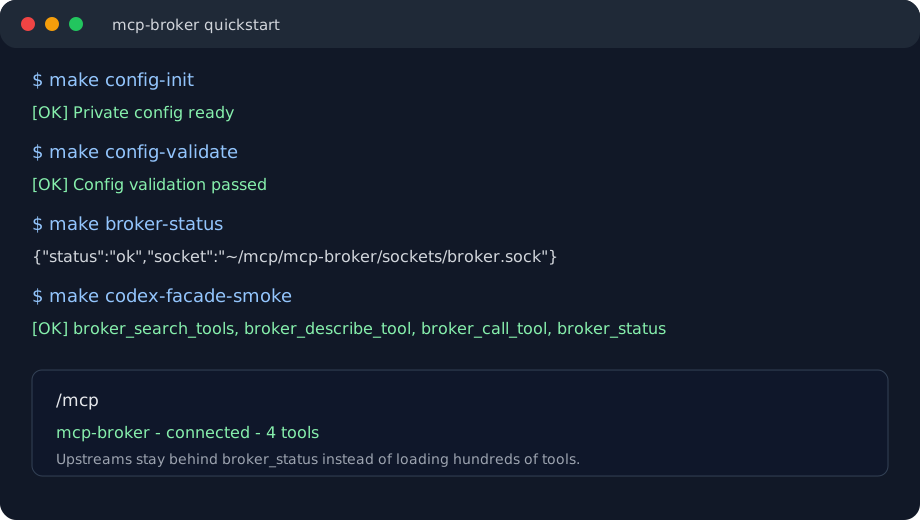
`text
make config-init
make config-validate
make broker-status
make codex-facade-smoke
`
In an MCP client, /mcp should show one mcp-broker entry. Use broker_status
to inspect profile-visible upstream state.
Quickstart
Prerequisites:
- macOS with launchctl for LaunchAgent use.
- Python 3.10 or newer available as python3.
- make.
- Node.js and npx for npm-based upstream MCP servers.
- A clone of this repo.
Package installs:
`bash
pipx install mcp-broker
uv tool install mcp-broker
brew tap NavinAgrawal/tap
brew install mcp-broker
`
Homebrew installs the same console scripts as the Python package. Package

installs do not write MCP client config; client wiring stays an explicit

Makefile action.


Docker is for container-friendly configs:
`bash
docker build -t mcp-broker:local .
docker run --rm -i mcp-broker:local
`
Local stdio clients and MCPB-style installs use the package-owned lifecycle:
`bash
mcp-broker stdio --init-if-missing
`
Create the local venv, install dependencies, and verify runtime layout:
`bash
make setup
`
Create private config from the public template:
`bash
make config-init
`
config-init creates the destination directory when needed and copies the public
template as the starting point. It does not import local MCP inventory, user
paths, or secrets.
Edit config/broker.private.yaml for local upstreams. Keep secret values out of config. Use environment variable names or files under:
`text
$HOME/mcp/mcp-broker/secrets/
`
Run the quality gate:
`bash
make quality-gate
`
Validate the configured YAML contract:
`bash
make config-validate
`
Start the broker:
`bash
make broker-start
`
Check status:
`bash
make broker-status
`
For the full install flow, see docs/install.md.

Runtime layout


Default runtime root:
`text
$HOME/mcp/mcp-broker/
|- backups/
|- logs/
|- renders/
|- run/
|- secrets/
|- sockets/
- state/
- upstreams/
`
Runtime files are not repo files. Upstream OAuth state, browser state, secret files, sockets, logs, rendered client configs, backups, and daemon state belong under the runtime root.

See docs/runtime-layout.md.

Client wiring


Back up a client config:
`bash
make config-backup CLIENT=codex
`
Dry-run render:
`bash
make config-render CLIENT=codex CONFIG_RENDER_APPLY=0
`
Apply after reviewing the rendered file under $HOME/mcp/mcp-broker/renders/:
`bash
make config-render CLIENT=codex CONFIG_RENDER_APPLY=1
`
Rollback:
`bash
make config-rollback CLIENT=codex
`
Use CLIENT=claude or CLIENT=gemini after that profile smoke passes and that
client is intended to use the broker. For new JSON-based MCP clients, generate a
starter block:
`bash
make profile-snippet NEW_PROFILE=local-client NEW_CLIENT_FORMAT=mcp-settings-json
`
See docs/add-profile.md for the full new-profile flow.

Compact broker facade


The compact facade keeps chat-facing profiles small:

| Tool | Purpose |
|---|---|
|
broker_search_tools | Search configured upstream tools by query. |
| broker_describe_tool | Return schema and metadata for one upstream tool. |
| broker_call_tool | Call one upstream tool through broker routing. |
| broker_status | Show profile-visible upstream state, passive auth probes, and last errors without starting tools. |
Codex /mcp shows the single mcp-broker entry by design. Per-upstream visibility, status, and socket path come from broker_status.
Profiles and safety
Profiles decide which upstreams a client can see and call.
Supported concepts:
- max_tools protects clients from huge tool lists.
- compact_tools_enabled exposes broker facade tools instead of raw upstream tools.
- broker_tool_name_style adapts broker facade names for clients that cannot surface dotted tool names.
- mcp_allowed_servers renders client settings for MCP clients that require an explicit server allowlist.
- allow_mutating_upstreams is required before a mutating upstream can be exposed.
- shared mode reuses one upstream process where shared account state is acceptable.
- per_session mode isolates upstream state per client session.
- disabled mode keeps compatibility records without exposing the upstream.
Protected surfaces such as OAuth, browser state, filesystem roots, and databases require explicit config and validation. Public examples stay disabled or placeholder-based.
See docs/security-review.md and docs/upstream-compatibility-matrix.md.
For a deeper safety checklist, see docs/safety.md.
Config contract
The public template is config/broker.example.yaml.
The matching JSON Schema is config/broker.schema.json.
Supported top-level sections:
`yaml
schema_version: 1
runtime: {}
broker: {}
profiles: {}
clients: {}
upstreams: {}
`
The loader rejects unknown keys. Runtime placeholders such as {runtime.root}, {runtime.state_dir}, and {runtime.secrets_dir} can be used in upstream command, args, working directory, and env file paths.
make config-validate checks the selected CONFIG_PATH against the public JSON Schema first, then runs the runtime loader so semantic rules are enforced from the same code path the broker uses.
Each enabled upstream exposed to a profile should define a safe smoke probe:
`yaml
smoke:
query: read example graph
tool: example-store.read_graph
arguments: {}
call: true
`
make profile-validation PROFILE=<profile> validates every enabled upstream visible to that profile through broker_status, broker_search_tools, broker_describe_tool, and the configured safe broker_call_tool.
Codex operator acceptance
Repo-owned tests validate broker behavior through the local client shim. The last
Codex-specific check has to run inside an active Codex session because that is
where the deferred MCP wrapper tools exist.
Generate the current acceptance steps from YAML:
`bash
make codex-deferred-acceptance
`
The target reads the configured smoke probes and prints the exact
mcp__mcp_broker__ wrapper calls for search, describe, and safe call. It does
not invoke Codex, does not call an external LLM session, and is not part of
make quality-gate.
See docs/codex-deferred-tool-acceptance.md.
LaunchAgent
Render without writing:
`bash
make launchagent-install
`
Apply and load:
`bash
make launchagent-install LAUNCHAGENT_APPLY=1
make launchagent-load
make broker-status
`
Unload or remove:
`bash
make launchagent-unload
make launchagent-uninstall LAUNCHAGENT_APPLY=1
`
systemd


Linux user-service install uses the same runtime root and config path contract:
`bash
make systemd-install
make systemd-install SYSTEMD_APPLY=1
make systemd-load
`
For package installs, set MCP_BROKER_DAEMON_COMMAND to the installed daemon
path before applying the service.
Windows
Windows startup uses PowerShell Scheduled Task commands with the same runtime
root and config path contract:
`bash
make windows-install
make windows-install WINDOWS_APPLY=1
make windows-load
`
Remove it with:
`bash
make windows-unload
make windows-uninstall WINDOWS_APPLY=1
`
Test and release gates


Run all test tiers:
`bash
make test
`
Run the public quality gate:
`bash
make quality-gate
`
The coverage gate uses line and branch coverage for Python source.

Run the release gate when preparing a tag:
`bash
make release-gate
`
release-gate runs package, smoke, and mutation checks. Mutation
runs public unit and journey tests last and writes
var/quality/mutation_stats.json with total counts, score, and ranked
blocked_by_file entries. On macOS, the release gate runs mutation inside a
Linux container to avoid local mutmut fork failures. E2E tests remain in make
quality-gate.
Run smoke and runtime cleanup checks:
`bash
make config-validate
make broker-smoke
make broker-stop
make broker-reap
make doctor
make release-smoke
`
Release or client config apply should wait for:

-
make quality-gate
- make config-validate
- make broker-smoke
- dry-run config render for each intended client
- rollback test
-
make release-smoke
- make release-gate before tagging
- make doctor with no stale broker-owned resources
See docs/release-checklist.md.
Public commands
These targets use this repo plus declared Python and Node prerequisites:
`bash
make setup
make config-init
make test
make test-unit
make test-journey
make test-live
make test-e2e
make test-cov
make precommit
make quality-gate
make release-gate
make config-validate
make broker-smoke
make broker-start
make broker-status
make broker-stop
make broker-reap
make doctor
make config-backup
make codex-app-policy
make config-render
make config-rollback
make tools-count
make facade-smoke
make codex-facade-smoke
make claude-facade-smoke
make gemini-facade-smoke
make profile-validation
make codex-profile-validation
make claude-profile-validation
make gemini-profile-validation
make discovery-parity
make codex-claude-discovery-parity
make codex-deferred-acceptance
make launchagent-install
make launchagent-load
make launchagent-unload
make launchagent-uninstall
make systemd-install
make systemd-load
make systemd-unload
make systemd-uninstall
make windows-install
make windows-load
make windows-unload
make windows-uninstall
make linux-container-smoke
make windows-powershell-smoke
make release-smoke
make mutation
make mutation-linux
`
make quality-gate is repo-local. It does not call personal scripts outside this repo.
make codex-deferred-acceptance is maintainer-only. It does not invoke Codex
or an external LLM session. It reads the same YAML smoke probes and prints the
exact mcp__mcp_broker__ deferred wrapper calls to run inside an active Codex
session. See docs/codex-deferred-tool-acceptance.md.
Project tree
`text
mcp-broker/
|- .gitignore
|- Makefile
|- README.md
|- pyproject.toml
|- requirements.txt
|- config/
| |- broker.example.yaml
| |- broker.private.yaml # local, ignored by git
| - broker.schema.json
|- docs/
|- registry/
|- scripts/
| - check_mutation_stats.py
|- src/
| - mcp_broker/
|- tests/
| |- unit/
| |- journey/
| |- live/
| |- e2e/
| - support/
- var/ # tracked skeleton; generated contents ignored
``
Generated reports stay under var/, especially var/coverage/, var/test-logs/, and var/quality/.
Docs
- SECURITY.md
- CONTRIBUTING.md
- ROADMAP.md
- docs/install.md
- docs/add-profile.md
- docs/migration.md
- docs/adoption-guide.md
- docs/comparison.md
- docs/distribution.md
- docs/github-publication.md
- docs/community-launch.md
- docs/auth-recipes.md
- docs/architecture.md
- docs/protocol.md
- docs/runtime-layout.md
- docs/safety.md
- docs/security-review.md
- docs/upstream-compatibility-matrix.md
- docs/codex-deferred-tool-acceptance.md
- docs/context-reduction-measurement.md
- docs/mutation-testing.md
- docs/release-checklist.md
- docs/troubleshooting.md
Design rules
- Keep upstream definitions in central config.
- Keep runtime state under $HOME/mcp/mcp-broker.
- Keep private upstream inventory in config/broker.private.yaml`, which is ignored by git.
- Keep secret values out of config and source.
- Do not hardcode personal paths in source, tests, docs, or public config.
- Run build, test, runtime, and config operations through the Makefile.Sign in to leave a review
Use Google, GitHub, or an email account so ratings stay tied to real people.
No reviews posted yet.