
Swiss Army Knife for MCP Servers
About
A command-line interface for interacting with MCP (Model Context Protocol) servers using both stdio and HTTP transport.
Details
- License
- MIT
Explore
MCP Tools supports a wide range of features for interacting with MCP servers:
Usage:
  mcp [command]
Available Commands:

  version       Print the version information

  tools         List available tools on the MCP server

  resources     List available resources on the MCP server

  prompts       List available prompts on the MCP server

  call          Call a tool, resource, or prompt on the MCP server

  get-prompt    Get a prompt on the MCP server

  read-resource Read a resource on the MCP server

  shell         Start an interactive shell for MCP commands

  web           Start a web interface for MCP commands

  mock          Create a mock MCP server with tools, prompts, and resources

  proxy         Proxy MCP tool requests to shell scripts

  alias         Manage MCP server aliases

  configs       Manage MCP server configurations

  new           Create a new MCP project component

  help          Help about any command

  completion    Generate the autocompletion script for the specified shell
Flags:

  -f, --format string   Output format (table, json, pretty) (default "table")

  -h, --help            help for mcp

  -p, --params string   JSON string of parameters to pass to the tool (for call command) (default "{}")
Use "mcp [command] --help" for more information about a command.

Setting up with Highlight
This MCP is not yet compatible with Highlight’s one-click setup. However, you can still use it with Highlight by following these steps:
- Download and install Highlight from highlightai.com/download
- Navigate to the plugins tab and select "Add Custom Plugin"
-
Configure the plugin with the settings below
Plugin Name
Swiss Army Knife for MCP ServersCommand (node, npx, python, etc.)Please refer to the README for specific instructions on how to obtain API keys or other required environment variables.
- Enable "Start Automatically" if you want the plugin to start when Highlight launches





From the repository
The simplest way to start using MCP Tools is to connect to an MCP server and list available tools:
npm install
MCP Tools provides a powerful configuration management system that helps you work with MCP server configurations across multiple applications:
> 🚧 This works only on macOS for now.
mcp configs scan
mcp configs ls
mcp configs view vscode
mcp configs set vscode my-server npm run mcp-server
mcp configs set cursor my-api https://api.example.com/mcp --headers "Authorization=Bearer token"
mcp configs set vscode,cursor,claude-desktop my-server npm run mcp-server
mcp configs remove vscode my-server
mcp configs alias myapp ~/myapp/config.json
mcp configs sync vscode cursor --output vscode --default interactive
mcp configs as-json mcp proxy start
mcp configs as-json https://api.example.com/mcp --headers "Authorization=Bearer token"
if [ -z "$a" ] || [ -z "$b" ]; then
echo "Error: Missing required parameters 'a' or 'b'"
exit 1
fi
- Tools are registered in ~/.mcpt/proxy_config.json
- The proxy server logs all requests and responses to ~/.mcpt/logs/proxy.log
- Use --unregister to remove a tool from the configuration
List tools from a filesystem server:
mcp tools npx -y @modelcontextprotocol/server-filesystem ~
Call a tool with pretty JSON output:
mcp call read_file --params '{"path":"README.md"}' --format pretty npx -y @modelcontextprotocol/server-filesystem ~
Use the guard mode to filter available tools:
mcp guard --deny tools:write_,delete_,create_,move_ npx -y @modelcontextprotocol/server-filesystem ~
Create and run a local streamable HTTP server:
npm install && npm run build
mcp tools https://authenticated-mcp-server.com
mcp tools npx -y @modelcontextprotocol/server-filesystem ~
mcp call read_file --params '{"path":"README.md"}' npx -y @modelcontextprotocol/server-filesystem ~
mcp tools npx -y @modelcontextprotocol/server-filesystem ~
mcp call read_file --params '{"path":"/path/to/file"}' npx -y @modelcontextprotocol/server-filesystem ~
mcp tools --server-logs npx -y @modelcontextprotocol/server-filesystem ~
Output:
[>] Secure MCP Filesystem Server running on stdio
[>] Allowed directories: [ '/Users/fka/' ]
read_file(path:str)
Read the complete contents of a file from the file system.
read_multiple_files(paths:str[])
Read the contents of multiple files simultaneously.
... and the other tools available on this server
This can be helpful for debugging or understanding what's happening on the server side when executing these commands.
mcp > read_file {"path":"README.md"}
...content of README.md...
mcp > edit_file {"path":"main.go","edits":[{"oldText":"foo","newText":"bar"}]}
...result of edit operation...
mcp tools node build/index.js
Project templates are stored in either:
- Local ./templates/ directory
- User's home directory: ~/.mcpt/templates/
- Homebrew installation path (/opt/homebrew/Cellar/mcp/v#.#.#/templates)
When installing via Homebrew, templates are automatically installed to your home directory. But if you use source install, you need to run make install-templates.
mcp mock tool hello_world "A simple greeting tool"
mcp proxy tool add_operation "Adds a and b" "a:int,b:int" ./examples/add.sh
mcp proxy tool add_operation "Adds a and b" "a:int,b:int" -e 'echo "total is $a + $b = $(($a+$b))"'
mcpt proxy tool add_operation "Adds a and b with optional result msg" "a:int,b:int,[msg:string]" -e 'echo "$msg$a + $b = $(($a+$b))"'
mcp proxy tool --unregister add_operation
mcp proxy tool qrcode "Generates a QR code" "text:string" \
-e 'echo -e "data:image/png;base64,$(qrencode -t png -o - "$text" | base64 -w 0)"'
Inline Command Example:
mcp guard --allow 'tools:search_files' npx -y @modelcontextprotocol/server-filesystem ~
mcp guard --allow 'tools:read_,prompts:system_' --deny tools:execute_* npx -y @modelcontextprotocol/server-filesystem ~
mcp call example_tool --params '{"input": "test"}' http://localhost:3000/sse
mcp proxy tool add_numbers "Adds two numbers" "a:int,b:int" ./add.sh
mcp call add_numbers --params '{"a":5,"b":3}' --format pretty
```
Claude Desktop / Cursor
Paste into your MCP client config file to install this server.
{
    "mcpServers": {
        "swiss army knife for mcp servers": {
            "mcptools": {
                "command": "docker",
                "args": [
                    "run",
                    "-i",
                    "--rm",
                    "-e",
                    "GITHUB_PERSONAL_ACCESS_TOKEN",
                    "ghcr.io/github/github-mcp-server"
                ]
            }
        }
    }
}McpServers
{
    "mcptools": {
        "command": "docker",
        "args": [
            "run",
            "-i",
            "--rm",
            "-e",
            "GITHUB_PERSONAL_ACCESS_TOKEN",
            "ghcr.io/github/github-mcp-server"
        ]
    }
}
<p align="center">

</p>
<p align="center">
<h1 align="center">Swiss Army Knife for MCP Servers</h1>
<p align="center">
A comprehensive command-line interface for interacting with MCP (Model Context Protocol) servers.
<br>
Discover, call, and manage tools, resources, and prompts from any MCP-compatible server.
<br>
Supports multiple transport methods, output formats, and includes powerful mock and proxy server capabilities.
</p>
</p>

Table of Contents
- Overview
- Difference Between the MCP Inspector and MCP Tools
- Installation
- Using Homebrew
- From Source
- Getting Started
- Features
- Transport Options
- Output Formats
- Commands
- Interactive Shell
- Web Interface
- Project Scaffolding
- Server Aliases
- LLM Apps Config Management
- Server Modes
- Mock Server Mode
- Proxy Mode
- Guard Mode
- Examples
- Basic Usage
- Script Integration
- Debugging
- Contributing
- Roadmap
- License
Overview
MCP Tools provides a versatile CLI for working with Model Context Protocol (MCP) servers. It enables you to:
- Discover and call tools provided by MCP servers
- Access and utilize resources exposed by MCP servers
- Create mock servers for testing client applications
- Proxy MCP requests to shell scripts for easy extensibility
- Create interactive shells for exploring and using MCP servers
- Scaffold new MCP projects with TypeScript support
- Format output in various styles (JSON, pretty-printed, table)
- Guard and restrict access to specific tools and resources
- Support all transport methods (HTTP, stdio)
<p align="center">
</p>
Installation
Using Homebrew (for macOS)
brew tap f/mcptools
brew install mcp
> ❕ The binary is installed as mcp but can also be accessed as mcpt to avoid conflicts with other tools that might use the mcp command name.
From Source (for Windows and GNU/Linux)
go install github.com/f/mcptools/cmd/mcptools@latest
> ❕ The binary will be installed as mcptools when but can be aliased to mcpt for convenience.
>
>
>
> <sub>Windows 11 Running Example</sub>
Getting Started
The simplest way to start using MCP Tools is to connect to an MCP server and list available tools:
# List all available tools from a filesystem server
mcp tools npx -y @modelcontextprotocol/server-filesystem ~
Call a specific tool
mcp call read_file --params '{"path":"README.md"}' npx -y @modelcontextprotocol/server-filesystem ~
Open an interactive shell
mcp shell npx -y @modelcontextprotocol/server-filesystem ~
Features
MCP Tools supports a wide range of features for interacting with MCP servers:
Usage:
  mcp [command]
Available Commands:

  version       Print the version information

  tools         List available tools on the MCP server

  resources     List available resources on the MCP server

  prompts       List available prompts on the MCP server

  call          Call a tool, resource, or prompt on the MCP server

  get-prompt    Get a prompt on the MCP server

  read-resource Read a resource on the MCP server

  shell         Start an interactive shell for MCP commands

  web           Start a web interface for MCP commands

  mock          Create a mock MCP server with tools, prompts, and resources

  proxy         Proxy MCP tool requests to shell scripts

  alias         Manage MCP server aliases

  configs       Manage MCP server configurations

  new           Create a new MCP project component

  help          Help about any command

  completion    Generate the autocompletion script for the specified shell
Flags:

  -f, --format string   Output format (table, json, pretty) (default "table")

  -h, --help            help for mcp

  -p, --params string   JSON string of parameters to pass to the tool (for call command) (default "{}")
Use "mcp [command] --help" for more information about a command.
Transport Options
MCP Tools supports multiple transport methods for communicating with MCP servers:
Stdio Transport
Uses stdin/stdout to communicate with an MCP server via JSON-RPC 2.0. This is useful for command-line tools that implement the MCP protocol.
mcp tools npx -y @modelcontextprotocol/server-filesystem ~
HTTP SSE Transport
Uses HTTP and Server-Sent Events (SSE) to communicate with an MCP server via JSON-RPC 2.0. This is useful for connecting to remote servers that implement the legacy MCP protocol. Transport is automatically detected when the URL ends with /sse.
mcp tools http://localhost:3001/sse
Example: Use the everything sample server
docker run -p 3001:3001 --rm -it tzolov/mcp-everything-server:v1
_Note:_ HTTP SSE currently supports only MCP protocol version 2024-11-05.
Streamable HTTP Transport (Recommended)
Uses streamable HTTP to communicate with an MCP server via JSON-RPC 2.0. This is the modern, recommended approach for connecting to remote servers that implement the MCP protocol. It supports both streaming responses and simple request/response patterns. This is the default transport for HTTP/HTTPS URLs.
# Default transport for HTTP URLs
mcp tools http://localhost:3000
Streamable HTTP transport (auto-detected from URL)
mcp tools http://localhost:3000
Examples with remote servers
mcp tools https://api.example.com/mcp
mcp tools https://ne.tools
_Benefits of Streamable HTTP:_
- Session Management: Supports stateful connections with session IDs
- Resumability: Can reconnect and resume interrupted sessions (when supported by server)
- Flexible Responses: Supports both streaming and direct JSON responses
- Modern Protocol: Uses the latest MCP transport specification
Output Formats
MCP Tools supports three output formats to accommodate different needs:
Table Format (Default)
mcp tools npx -y @modelcontextprotocol/server-filesystem ~
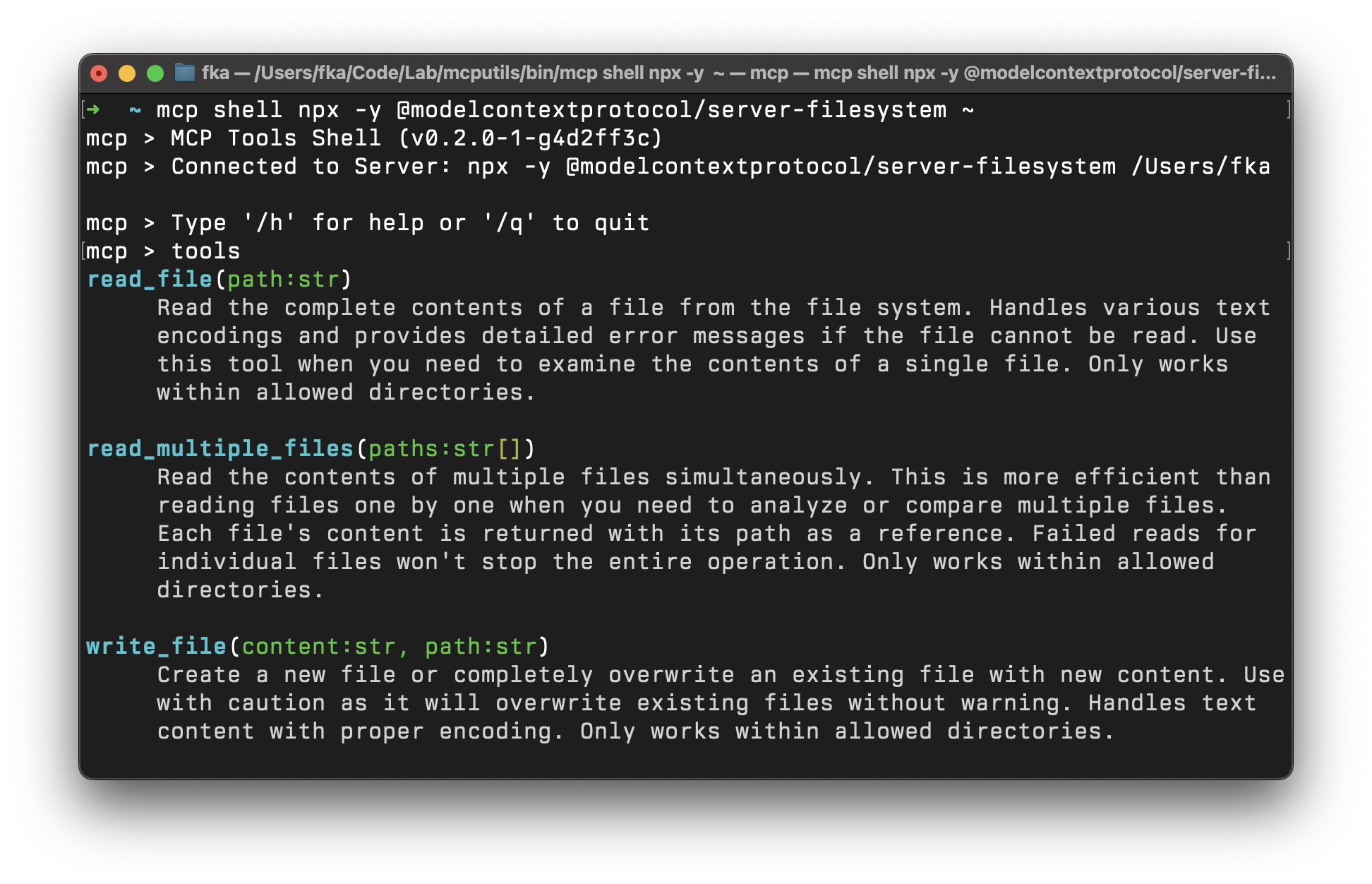
The default format now displays tools in a colorized man-page style:
read_file(path:str)
     Read the complete contents of a file from the file system.
read_multiple_files(paths:str[])
     Read the contents of multiple files simultaneously.
list_dir(path:str)
     Lists the contents of a directory.
write_file(path:str, content:str)
     Writes content to a file.
grep_search(pattern:str, [excludePatterns:str[]])
     Search files with pattern.
edit_file(edits:{newText:str,oldText:str}[], path:str)
     Edit a file with multiple text replacements
…
Sign in to leave a review
Use Google, GitHub, or an email account so ratings stay tied to real people.
No reviews posted yet.