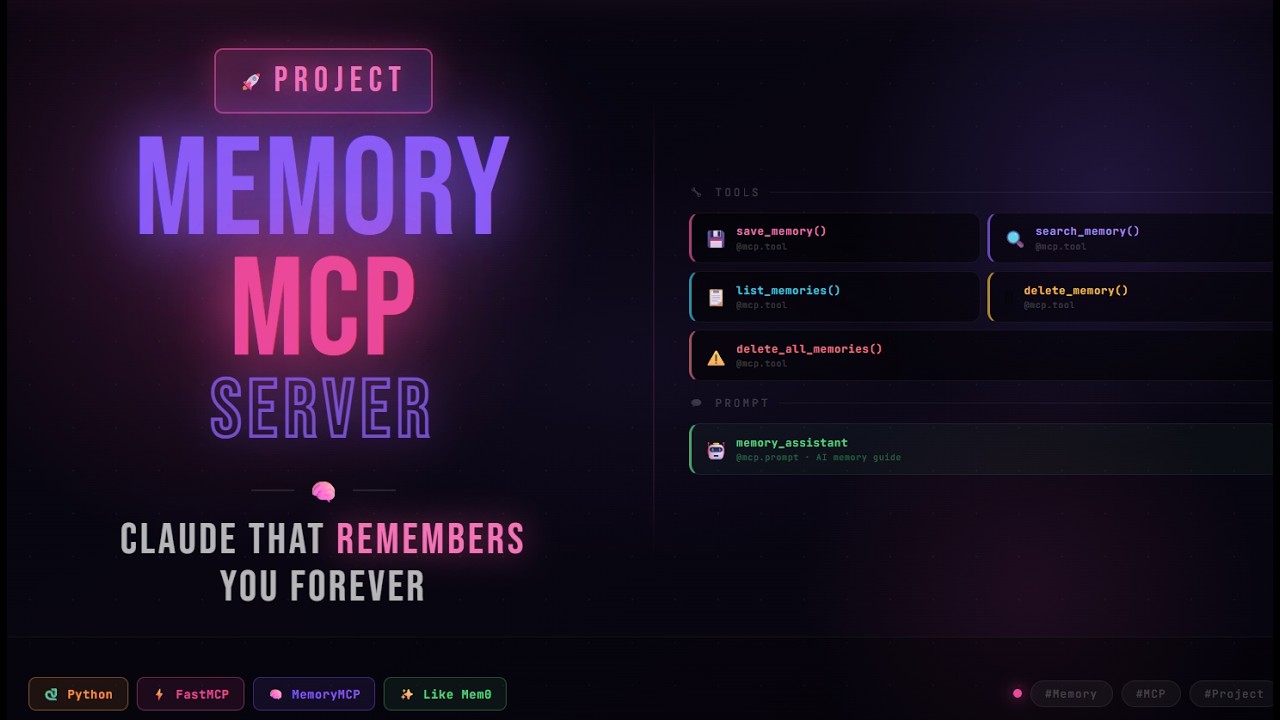
Memory MCP Server
About
A Model Context Protocol server that provides knowledge graph management capabilities.
Details
- Transport
- SSE
Explore
Knowledge Graph Storage: Maintain a persistent graph of entities and their relationships
Entity Management: Create, retrieve, update, and delete entities with custom types
Relation Tracking: Define and manage relationships between entities in active voice
Observation System: Add and remove observations about entities over time
Powerful Search: Find relevant nodes by name, type, or observation content
Persistent Storage: Data persists between sessions in a simple JSON format
The easiest way to install is with the one-line installer, which automatically downloads the latest version and installs it to ~/.local/bin in your home directory:
curl -fsSL https://raw.githubusercontent.com/okooo5km/memory-mcp-server/main/install.sh | bash
The installer will:
Create ~/.local/bin if it doesn't exist
Add this directory to your PATH (in .zshrc or .bashrc)
Download and install the latest version
Make the binary executable
mkdir -p ~/.local/bin
cp $(swift build -c release --show-bin-path)/memory-mcp-server ~/.local/bin/
Make sure ~/.local/bin is in your PATH by adding to your shell configuration file:
echo 'export PATH="$HOME/.local/bin:$PATH"' >> ~/.zshrc # or ~/.bashrc
source ~/.zshrc # or source ~/.bashrc
The server supports the following environment variables:
 MEMORY_FILE_PATH: Custom path for storing the knowledge graph (optional)

   If not specified, defaults to memory.json in the current working directory

  * Can be an absolute path or relative to the current working directory
You can check the configured file path in the server logs when starting the server.
export MEMORY_FILE_PATH="/path/to/your/memory.json"
Add to your Claude settings:
"mcpServers": {
"memory": {
"command": "memory-mcp-server",
"env": {
"MEMORY_FILE_PATH": "/path/to/your/memory.json"
}
}
}
Add the following configuration to your Cursor editor's Settings - mcp.json:
{
"mcpServers": {
"memory": {
"command": "memory-mcp-server",
"env": {
"MEMORY_FILE_PATH": "/path/to/your/memory.json"
}
}
}
}
```

Add the memory MCP server to your Chatwise Settings - Tools.

create_entities
Create multiple new entities in the knowledge graph
entities
(array, required): Array of entity objects to create
name
(string): The name of the entity
entityType
(string): The type of the entity
observations
(array of strings): Observations associated with the entity
create_relations
Create multiple new relations between entities
relations
(array, required): Array of relation objects
from
(string): The name of the entity where the relation starts
to
(string): The name of the entity where the relation ends
relationType
(string): The type of the relation (in active voice)
add_observations
Add new observations to existing entities
entityName
(string): The name of the entity to add observations to
contents
(array of strings): The observations to add
delete_entities
Delete multiple entities and their associated relations
entityNames
(array, required): Array of entity names to delete
delete_observations
Delete specific observations from entities
deletions
(array, required): Array of observation deletions
delete_relations
Delete multiple relations from the knowledge graph
read_graph
Read the entire knowledge graph
search_nodes
Search for nodes in the knowledge graph based on a query
query
(string, required): Search query to match against entity names, types, and observations
open_nodes
Open specific nodes in the knowledge graph by their names
names
(array, required): Array of entity names to retrieve
create_entities - Create multiple new entities in the knowledge graph
entities (array, required): Array of entity objects to create
name (string): The name of the entity
entityType (string): The type of the entity
observations (array of strings): Observations associated with the entity
create_relations - Create multiple new relations between entities
relations (array, required): Array of relation objects
from (string): The name of the entity where the relation starts
to (string): The name of the entity where the relation ends
relationType (string): The type of the relation (in active voice)
add_observations - Add new observations to existing entities
observations (array, required): Array of observation additions
entityName (string): The name of the entity to add observations to
contents (array of strings): The observations to add
delete_entities - Delete multiple entities and their associated relations
entityNames (array, required): Array of entity names to delete
delete_observations - Delete specific observations from entities
deletions (array, required): Array of observation deletions
entityName (string): The name of the entity containing the observations
observations (array of strings): The observations to delete
delete_relations - Delete multiple relations from the knowledge graph
relations (array, required): Array of relation objects to delete
from (string): The source entity name
to (string): The target entity name
relationType (string): The relation type
read_graph - Read the entire knowledge graph
No parameters required
search_nodes - Search for nodes in the knowledge graph based on a query
query (string, required): Search query to match against entity names, types, and observations
open_nodes - Open specific nodes in the knowledge graph by their names
* names (array, required): Array of entity names to retrieve
> A Model Context Protocol server that provides knowledge graph management capabilities. This server enables LLMs to create, read, update, and delete entities and relations in a persistent knowledge graph, helping AI assistants maintain memory across conversations. This is a Swift implementation of the official TypeScript Memory MCP Server.
Note: This Swift version requires macOS 14.0 or later. For broader platform support (including Windows, Linux, and macOS 11.0+), check out the Go language implementation: memory-mcp-server-go.


✨ Features
Knowledge Graph Storage: Maintain a persistent graph of entities and their relationships
Entity Management: Create, retrieve, update, and delete entities with custom types
Relation Tracking: Define and manage relationships between entities in active voice
Observation System: Add and remove observations about entities over time
Powerful Search: Find relevant nodes by name, type, or observation content
Persistent Storage: Data persists between sessions in a simple JSON format
Available Tools
create_entities - Create multiple new entities in the knowledge graph
entities (array, required): Array of entity objects to create
name (string): The name of the entity
entityType (string): The type of the entity
observations (array of strings): Observations associated with the entity
create_relations - Create multiple new relations between entities
relations (array, required): Array of relation objects
from (string): The name of the entity where the relation starts
to (string): The name of the entity where the relation ends
relationType (string): The type of the relation (in active voice)
add_observations - Add new observations to existing entities
observations (array, required): Array of observation additions
entityName (string): The name of the entity to add observations to
contents (array of strings): The observations to add
delete_entities - Delete multiple entities and their associated relations
entityNames (array, required): Array of entity names to delete
delete_observations - Delete specific observations from entities
deletions (array, required): Array of observation deletions
entityName (string): The name of the entity containing the observations
observations (array of strings): The observations to delete
delete_relations - Delete multiple relations from the knowledge graph
relations (array, required): Array of relation objects to delete
from (string): The source entity name
to (string): The target entity name
relationType (string): The relation type
read_graph - Read the entire knowledge graph
No parameters required
search_nodes - Search for nodes in the knowledge graph based on a query
query (string, required): Search query to match against entity names, types, and observations
open_nodes - Open specific nodes in the knowledge graph by their names
names (array, required): Array of entity names to retrieve
Installation
Option 1: One-Line Installation (curl)
The easiest way to install is with the one-line installer, which automatically downloads the latest version and installs it to ~/.local/bin in your home directory:
curl -fsSL https://raw.githubusercontent.com/okooo5km/memory-mcp-server/main/install.sh | bash
The installer will:
Create ~/.local/bin if it doesn't exist
Add this directory to your PATH (in .zshrc or .bashrc)
Download and install the latest version
Make the binary executable
Option 2: Build from Source
1. Clone the repository:
   git clone https://github.com/okooo5km/memory-mcp-server.git
   cd memory-mcp-server
2. Build the project:
swift build -c release
3. Install the binary:
   # Install to user directory (recommended, no sudo required)
   mkdir -p ~/.local/bin
   cp $(swift build -c release --show-bin-path)/memory-mcp-server ~/.local/bin/
Make sure ~/.local/bin is in your PATH by adding to your shell configuration file:
   echo 'export PATH="$HOME/.local/bin:$PATH"' >> ~/.zshrc  # or ~/.bashrc
   source ~/.zshrc  # or source ~/.bashrc
Command Line Arguments
The server supports the following command line arguments:
-h, --help: Display help information about the server, its usage, and available options
-v, --version: Display the version number of the memory-mcp-server
Example usage:
```bash
Sign in to leave a review
Use Google, GitHub, or an email account so ratings stay tied to real people.
No reviews posted yet.