
napi - Better Software Architecture for the AI Age
About
napi is a fully offline CLI that analyzes your codebase's architecture—dependencies, complexity, and structure—then lets you visualize and refactor it, all without sending your code anywhere. It generates dependency manifests from source code, stores them locally, and serves an…
Explore
- 🔍 Dependency Analysis: Map every file, symbol, and dependency in your
codebase automatically.
- 🚨 Audit: Detect files and symbols that exceed complexity, size, or
coupling thresholds.
- 📊 Interactive Visualizer: Explore your architecture through Cytoscape.js
graphs served locally in your browser.
- 📝 Symbol Extraction: Extract specific functions, classes, or symbols into
standalone files for refactoring.
- 🏷️ AI Labeling (optional): Use OpenAI, Google, or Anthropic models to
auto-label dependencies.
- ⚙️ CI/CD Ready: Integrates into any pipeline -- generate manifests on
every push and track architecture over time.
- 🔒 Fully Offline: No accounts, no servers, no data leaves your machine.

Setting up with Highlight
This MCP is not yet compatible with Highlight’s one-click setup. However, you can still use it with Highlight by following these steps:
- Download and install Highlight from highlightai.com/download
- Navigate to the plugins tab and select "Add Custom Plugin"
-
Configure the plugin with the settings below
Plugin Name
napi - Better Software Architecture for the AI AgeCommand (node, npx, python, etc.)Please refer to the README for specific instructions on how to obtain API keys or other required environment variables.
- Enable "Start Automatically" if you want the plugin to start when Highlight launches





From the repository
Stored in your OS config directory (~/.config/napi/config.json on Linux,
~/Library/Application Support/napi/config.json on macOS). Managed via
napi set apiKey.
{
"labeling": {
"apiKeys": {
"openai": "sk-...",
"google": "AIza...",
"anthropic": "sk-ant-..."
}
}
}
```
deno install --allow-scripts
Claude Desktop / Cursor
Paste into your MCP client config file to install this server.
{
    "mcpServers": {
        "napi - better software architecture for the ai age": {
            "napi": {
                "command": "deno",
                "args": [
                    "task",
                    "dev"
                ]
            }
        }
    }
}McpServers
{
    "napi": {
        "command": "deno",
        "args": [
            "task",
            "dev"
        ]
    }
}
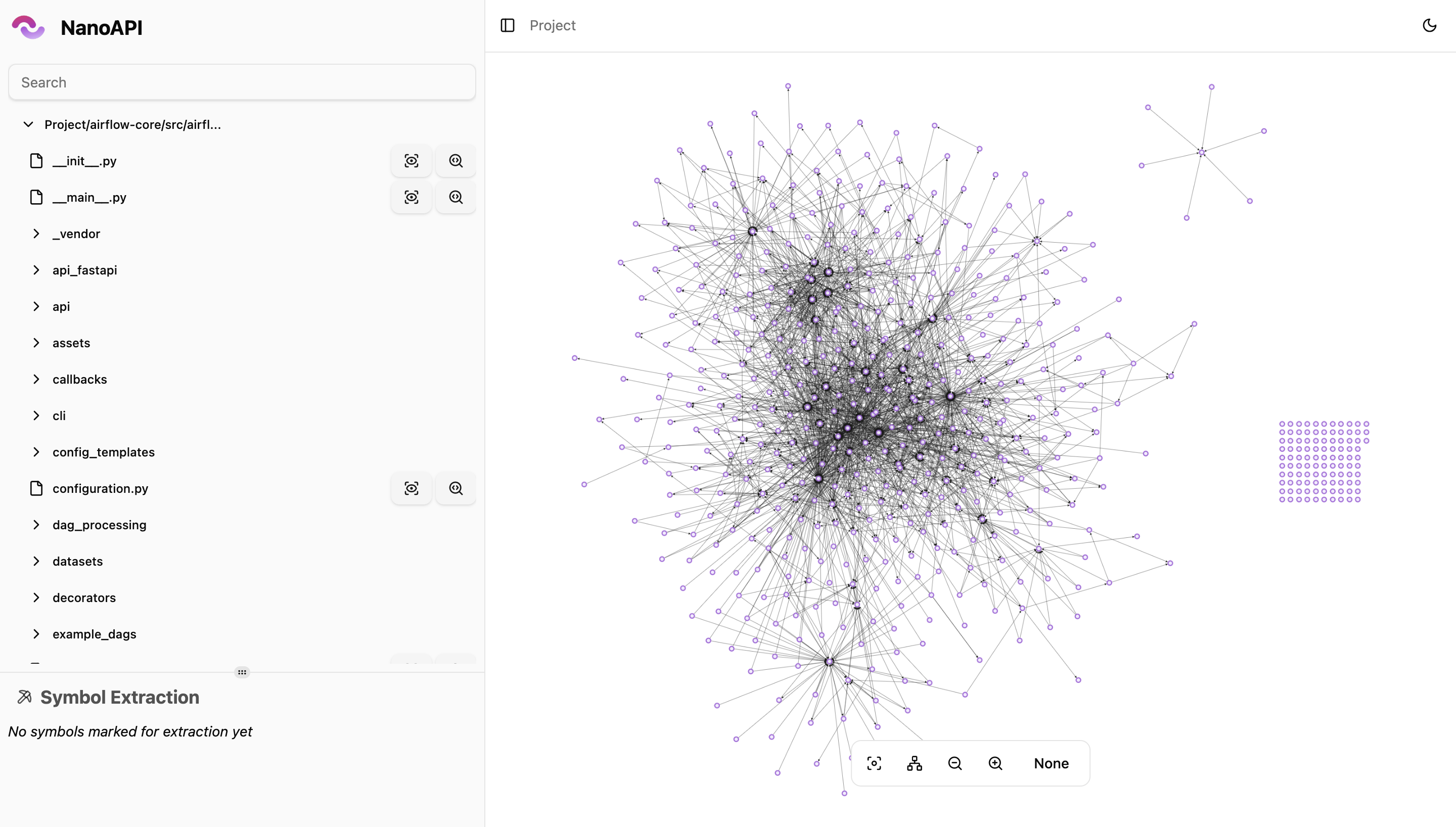
napi is a fully offline CLI that analyzes your codebase's architecture --
dependencies, complexity, and structure -- then lets you visualize and refactor
it, all without sending your code anywhere.
It generates dependency manifests from your source code, stores them locally,
and serves an interactive graph visualizer directly from the CLI.
Features
- 🔍 Dependency Analysis: Map every file, symbol, and dependency in your
codebase automatically.
- 🚨 Audit: Detect files and symbols that exceed complexity, size, or
coupling thresholds.
- 📊 Interactive Visualizer: Explore your architecture through Cytoscape.js
graphs served locally in your browser.
- 📝 Symbol Extraction: Extract specific functions, classes, or symbols into
standalone files for refactoring.
- 🏷️ AI Labeling (optional): Use OpenAI, Google, or Anthropic models to
auto-label dependencies.
- ⚙️ CI/CD Ready: Integrates into any pipeline -- generate manifests on
every push and track architecture over time.
- 🔒 Fully Offline: No accounts, no servers, no data leaves your machine.
Supported Languages
| Language | Status |
| -------- | -------------- |
| Python | ✅ Supported |
| C# | ✅ Supported |
| C | ✅ Supported |
| Java | ✅ Supported |
| C++ | 🚧 In Progress |
| PHP | 🚧 In Progress |
| JS/TS | 🚧 In Progress |
Installation
Unix (macOS, Linux)
curl -fsSL https://raw.githubusercontent.com/nanoapi-io/napi/refs/heads/main/install_scripts/install.sh | bash
Or download a binary directly from
GitHub Releases.
Windows
Use WSL to run napi.
Native Windows support is in progress.
Quick Start
```bash
Sign in to leave a review
Use Google, GitHub, or an email account so ratings stay tied to real people.
No reviews posted yet.