Next.js MCP Server
About
Help LLMs to understand your Next apps better
Explore
- get-routers-info
The Router Analyzer scans your Next.js app directory structure and extracts information about all API routes, including:
- API paths
- HTTP methods (GET, POST, PUT, DELETE, etc.)
- Request parameters
- Status codes
- Request and response schemas

Setting up with Highlight
This MCP is not yet compatible with Highlight’s one-click setup. However, you can still use it with Highlight by following these steps:
- Download and install Highlight from highlightai.com/download
- Navigate to the plugins tab and select "Add Custom Plugin"
-
Configure the plugin with the settings below
Plugin Name
Next.js MCP ServerCommand (node, npx, python, etc.)Please refer to the README for specific instructions on how to obtain API keys or other required environment variables.
- Enable "Start Automatically" if you want the plugin to start when Highlight launches





From the repository
npm install next-mcp-server
Or if you're using pnpm:
pnpm add next-mcp-server
Claude Desktop / Cursor
Paste into your MCP client config file to install this server.
{
    "mcpServers": {
        "next.js mcp server": {
            "next-mcp-server": {
                "command": "node",
                "args": [
                    "dist/index.js"
                ]
            }
        }
    }
}McpServers
{
    "next-mcp-server": {
        "command": "node",
        "args": [
            "dist/index.js"
        ]
    }
}
Demo
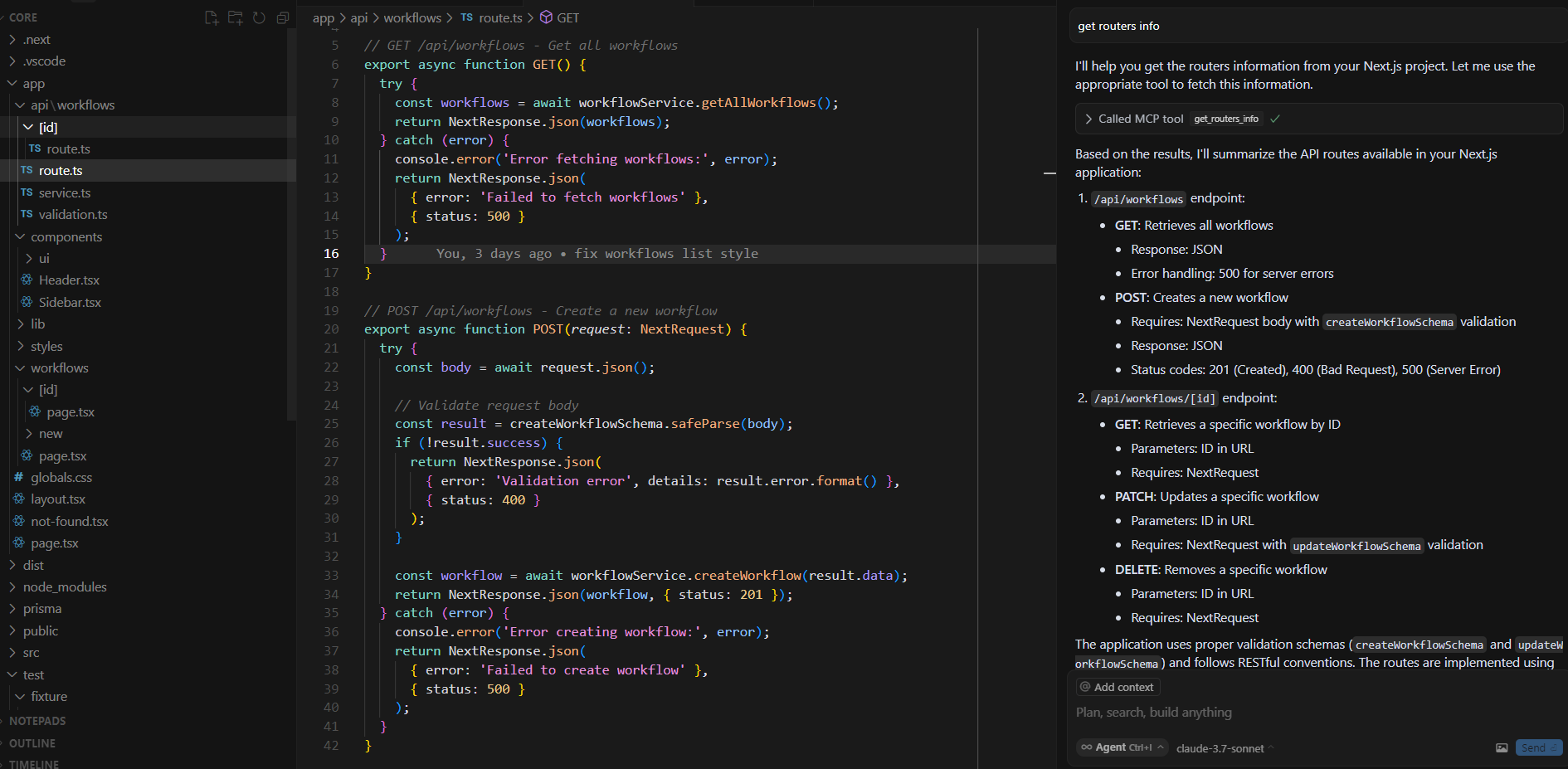
Features
- get-routers-info
The Router Analyzer scans your Next.js app directory structure and extracts information about all API routes, including:
- API paths
- HTTP methods (GET, POST, PUT, DELETE, etc.)
- Request parameters
- Status codes
- Request and response schemas
Installation
npm install next-mcp-server
Or if you're using pnpm:
pnpm add next-mcp-server
Usage
Command Line
You can run the mcp server directly:
npm run build
node dist/index.js
Docker
docker build -t mcp/next -f Dockerfile .
docker run mcp/next -d
For cursor usage, define a mcp.json under ~/.cursor or [projectDir]/.cursor
{
  "mcpServers": {
    "next.js": {
      "url": "http://localhost:4857/sse"
    }
  }
}
The url here could vary based on your .env settings within the project.
Output
The tool generates detailed information about each route:
[
  {
    "filePath": "/path/to/your/app/api/test/route.ts",
    "implementationPath": "/path/to/your/app/api/test/route.ts",
    "apiPath": "/api/test",
    "handlers": [
      {
        "method": "GET",
        "path": "/api/test",
        "functionSignature": "export async function GET(request: Request)",
        "description": "Get test data",
        "parameters": [],
        "statusCodes": [200]
      },
      {
        "method": "POST",
        "path": "/api/test",
        "functionSignature": "export async function POST(request: Request)",
        "description": "Create test data",
        "parameters": [],
        "requestBodySchema": "{ name: string }",
        "statusCodes": [201, 400]
      }
    ]
  }
]
Development
To run tests:
npm run test
To run the mcp server locally:
npm run build
node dist/index.js
To run it from node_modules after npm i:
node node_modules/next-mcp-server/dist/index.js
To run the playground:
pnpm --filter playground dev
How It Works
The tool:
1. Scans your Next.js app directory structure for route files
2. Analyzes each route file to extract HTTP methods, paths, parameters, etc.
3. Extracts documentation from comments
4. Returns a structured representation of all your API routes
Restrictions
1. Due to the nature of accessing filesystem directory by path, it will not work if hosted over network
2. Only supports Next.js App router projects
License
MIT
Sign in to leave a review
Use Google, GitHub, or an email account so ratings stay tied to real people.
No reviews posted yet.