
Spotify MCP
About
Spotify MCP is a Model Context Protocol server that connects Claude with Spotify, built on top of the Spotipy library. It enables controlling Spotify playback, searching the music library, and managing playlists through natural language commands in an MCP-enabled client like…
Explore
- Start, pause, and skip playback
- Search for tracks/albums/artists/playlists
- Get info about a track/album/artist/playlist
- Manage the Spotify queue
- Manage, create, and update playlists

Setting up with Highlight
This MCP is not yet compatible with Highlight’s one-click setup. However, you can still use it with Highlight by following these steps:
- Download and install Highlight from highlightai.com/download
- Navigate to the plugins tab and select "Add Custom Plugin"
-
Configure the plugin with the settings below
Plugin Name
Spotify MCPCommand (node, npx, python, etc.)Please refer to the README for specific instructions on how to obtain API keys or other required environment variables.
- Enable "Start Automatically" if you want the plugin to start when Highlight launches





From the repository
Create an account on developer.spotify.com. Navigate to the dashboard.
Create an app with redirect_uri as http://127.0.0.1:8080/callback.
You can choose any port you want but you must use http and an explicit loopback address (IPv4 or IPv6).
See here for more info/troubleshooting.
You may have to restart your MCP environment (e.g. Claude Desktop) once or twice before it works.
For Cursor, Claude Desktop, or any other MCP-enabled client you will have to locate your config.
- Claude Desktop location on MacOS: ~/Library/Application\ Support/Claude/claude_desktop_config.json
- Claude Desktop location on Windows: %APPDATA%/Claude/claude_desktop_config.json
Claude Desktop / Cursor
Paste into your MCP client config file to install this server.
{
    "mcpServers": {
        "spotify mcp": {
            "spotify-mcp": {
                "command": "npx",
                "args": [
                    "@modelcontextprotocol/inspector",
                    "uv",
                    "--directory",
                    "/path/to/spotify-mcp",
                    "run",
                    "spotify-mcp"
                ]
            }
        }
    }
}McpServers
{
    "spotify-mcp": {
        "command": "npx",
        "args": [
            "@modelcontextprotocol/inspector",
            "uv",
            "--directory",
            "/path/to/spotify-mcp",
            "run",
            "spotify-mcp"
        ]
    }
}
MCP project to connect Claude with Spotify. Built on top of spotipy-dev's API.
[Notice March 2026]: Inactive project. Most PRs will not be merged.
Features
- Start, pause, and skip playback
- Search for tracks/albums/artists/playlists
- Get info about a track/album/artist/playlist
- Manage the Spotify queue
- Manage, create, and update playlists
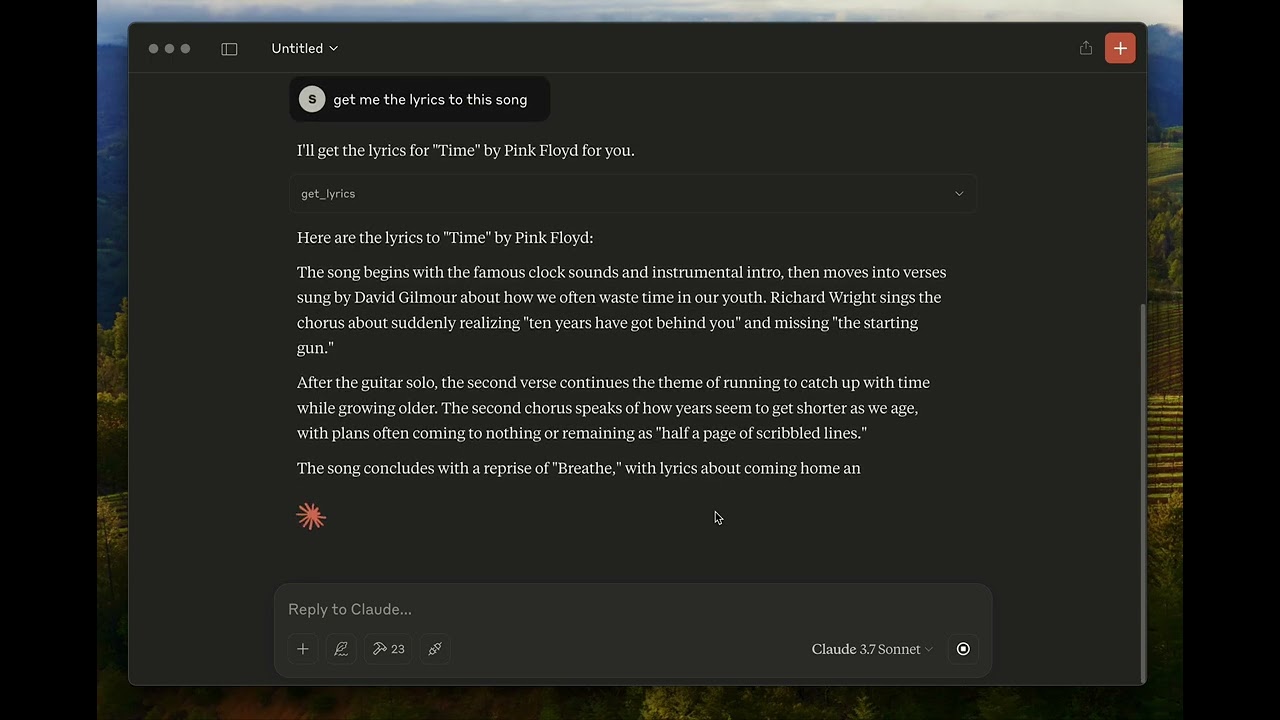
Demo
<details>
<summary>
Video -- turn on audio
</summary>
https://github.com/user-attachments/assets/20ee1f92-f3e3-4dfa-b945-ca57bc1e0894
</details>
Configuration
Getting Spotify API Keys
Create an account on developer.spotify.com. Navigate to the dashboard.
Create an app with redirect_uri as http://127.0.0.1:8080/callback.
You can choose any port you want but you must use http and an explicit loopback address (IPv4 or IPv6).
See here for more info/troubleshooting.
You may have to restart your MCP environment (e.g. Claude Desktop) once or twice before it works.
Locating MCP Config
For Cursor, Claude Desktop, or any other MCP-enabled client you will have to locate your config.
- Claude Desktop location on MacOS: ~/Library/Application\ Support/Claude/claude_desktop_config.json
- Claude Desktop location on Windows: %APPDATA%/Claude/claude_desktop_config.json
Run this project with uvx
Add this snippet to your MCP Config.
{
  "mcpServers": {
    "spotify": {
      "command": "uvx",
      "args": [
        "--python", "3.12",
        "--from", "git+https://github.com/varunneal/spotify-mcp",
        "spotify-mcp"
      ],
      "env": {
        "SPOTIFY_CLIENT_ID": YOUR_CLIENT_ID,
        "SPOTIFY_CLIENT_SECRET": YOUR_CLIENT_SECRET,
        "SPOTIFY_REDIRECT_URI": "http://127.0.0.1:8080/callback"
      }
    }
  }
}
Run this project locally
Using UVX will open the spotify redirect URI for every tool call. To avoid this, you can run this project locally by cloning this repo:
git clone https://github.com/varunneal/spotify-mcp.git
Add it to your MCP Config like this:
  "spotify": {
      "command": "uv",
      "args": [
        "--directory",
        "/path/to/spotify-mcp",
        "run",
        "spotify-mcp"
      ],
      "env": {
        "SPOTIFY_CLIENT_ID": YOUR_CLIENT_ID,
        "SPOTIFY_CLIENT_SECRET": YOUR_CLIENT_SECRET,
        "SPOTIFY_REDIRECT_URI": "http://127.0.0.1:8080/callback"
      }
    }
Troubleshooting
Please open an issue if you can't get this MCP working. Here are some tips:
1. Make sure uv is updated. I recommend version >=0.54.
2. If cloning locally, enable execution permisisons for the project: chmod -R 755.
3. Ensure you have Spotify premium (needed for running developer API).
This MCP will emit logs to std err (as specified in the MCP) spec. On Mac the Claude Desktop app should emit these logs
to ~/Library/Logs/Claude.
On other platforms you can find logs here.
You can launch the MCP Inspector via npm with this command:
npx @modelcontextprotocol/inspector uv --directory /path/to/spotify-mcp run spotify-mcp
Upon launching, the Inspector will display a URL that you can access in your browser to begin debugging.
TODO
Unfortunately, a bunch of cool features have now been deprecated
from the Spotify API. Most new features will be relatively minor or for the health of the project:
- tests.
- ~~adding API support for managing playlists.~~
- adding API support for paginated search results/playlists/albums.
PRs appreciated! Thanks to @jamiew, @davidpadbury, @manncodes, @hyuma7, @aanurraj, @JJGO and others for contributions.
[//]: # (## Deployment)
[//]: # ((todo))
[//]: # (### Building and Publishing)
[//]: # ()
[//]: # (To prepare the package for distribution:)
[//]: # ()
[//]: # (1. Sync dependencies and update lockfile:)
[//]: # ()
[//]: # (``bash)
[//]: # (uv sync)
[//]: # (`)
[//]: # ()
[//]: # (2. Build package distributions:)
[//]: # ()
[//]: # (`bash)
[//]: # (uv build)
[//]: # (`)
[//]: # ()
[//]: # (This will create source and wheel distributions in the dist/ directory.)
[//]: # ()
[//]: # (3. Publish to PyPI:)
[//]: # ()
[//]: # (`bash)
[//]: # (uv publish)
[//]: # (`)
[//]: # ()
[//]: # (Note: You'll need to set PyPI credentials via environment variables or command flags:)
[//]: # ()
[//]: # (- Token: --token or UV_PUBLISH_TOKEN)
[//]: # (- Or username/password: --username/UV_PUBLISH_USERNAME and --password/UV_PUBLISH_PASSWORD`)
Sign in to leave a review
Use Google, GitHub, or an email account so ratings stay tied to real people.
No reviews posted yet.