Zilliz Mcp Server
About
A Model Context Protocol (MCP) server seamlessly connecting AI Agents and AI coding tools with Zilliz Cloud https://zilliz.com/
Explore
- Create free Milvus clusters via natural language prompts.
- Perform semantic search on vector collections.
- Manage clusters with control plane tools (list, describe, suspend, resume).
- Insert, delete, and query vector entities.
- Query real-time cluster performance metrics.
- Combine vector similarity and scalar filters in hybrid search.

Setting up with Highlight
This MCP is not yet compatible with Highlight’s one-click setup. However, you can still use it with Highlight by following these steps:
- Download and install Highlight from highlightai.com/download
- Navigate to the plugins tab and select "Add Custom Plugin"
-
Configure the plugin with the settings below
Plugin Name
Zilliz Mcp ServerCommand (node, npx, python, etc.)Please refer to the README for specific instructions on how to obtain API keys or other required environment variables.
- Enable "Start Automatically" if you want the plugin to start when Highlight launches





From the repository
Configure the server in your MCP client using either Standard I/O (StdIO) via the uvx zilliz-mcp-server command with a ZILLIZ_CLOUD_TOKEN environment variable, or Streamable HTTP by cloning the repository, setting up a .env file with your Zilliz API key, and running uv run src/zilliz_mcp_server/server.py --transport streamable-http. Then your agent can leverage the exposed tools.
list_projects
List all projects scoped to API Key in Zilliz Cloud. Args: None Returns: JSON string containing the API response with projects data Example: '[{"project_name": "Default Project", "project_id": "proj-f5b02814db7ccfe2d16293", "instance_count": 0, "create_time": "2023-06-14T06:59:07Z"}]'
list_clusters
List all clusters scoped to API Key in Zilliz Cloud. If you want to list all clusters, you can set page_size to 100 and current_page to 1. Args: page_size: The number of records to include in each response (default: 10) current_page: The current page number (default: 1) Returns: List containing cluster data Example: [ { "cluster_id": "inxx-xxxxxxxxxxxxxxx", "cluster_name": "dedicated-3", "description": "", "region_id": "aws-us-west-2", "plan": "Standard", "cu_type": "Performance-optimized", "cu_size": 1, "status": "RUNNING", "connect_address": "https://inxx-xxxxxxxxxxxxxxx.aws-us-west-2.vectordb.zillizcloud.com:19530", "private_link_address": "", "project_id": "proj-xxxxxxxxxxxxxxxxxxxxxx", "create_time": "2024-06-30T16:49:50Z" } ]
create_free_cluster
Create a free cluster in Zilliz Cloud. Args: cluster_name: Name of the cluster to create project_id: ID of the project to which the cluster belongs Returns: Dict containing cluster creation info Example: { "cluster_id": "inxx-xxxxxxxxxxxxxxx", "username": "db_xxxxxxxx", "prompt": "successfully submitted, cluster is being created..." }
describe_cluster
Describe a cluster in detail. Args: cluster_id: ID of the cluster whose details are to return Returns: Dict containing detailed cluster information Example: { "cluster_id": "inxx-xxxxxxxxxxxxxxx", "cluster_name": "Free-01", "project_id": "proj-b44a39b0c51cf21791a841", "description": "", "region_id": "gcp-us-west1", "cu_type": "", "plan": "Free", "status": "RUNNING", "connect_address": "https://inxx-xxxxxxxxxxxxxxx.api.gcp-us-west1.zillizcloud.com", "private_link_address": "", "cu_size": 0, "storage_size": 0, "snapshot_number": 0, "create_progress": 100, "create_time": "2024-06-24T12:35:09Z" }
suspend_cluster
Suspend a dedicated cluster in Zilliz Cloud. Args: cluster_id: ID of the cluster to suspend Returns: Dict containing cluster suspension info Example: { "cluster_id": "inxx-xxxxxxxxxxxxxxx", "prompt": "Successfully Submitted. The cluster will not incur any computing costs when suspended. You will only be billed for the storage costs during this time." }
resume_cluster
Resume a dedicated cluster in Zilliz Cloud. Args: cluster_id: ID of the cluster to resume Returns: Dict containing cluster resumption info Example: { "cluster_id": "inxx-xxxxxxxxxxxxxxx", "prompt": "successfully Submitted. Cluster is being resumed, which is expected to takes several minutes. You can access data about the creation progress and status of your cluster by DescribeCluster API. Once the cluster status is RUNNING, you may access your vector database using the SDK." }
query_cluster_metrics
Query the metrics of a specific cluster. Args: cluster_id: ID of the target cluster start: Starting date and time in ISO 8601 timestamp format (optional, use with end) end: Ending date and time in ISO 8601 timestamp format (optional, use with start) period: Duration in ISO 8601 duration format (optional, use when start/end not set) granularity: Time interval for metrics reporting in ISO 8601 duration format (minimum PT30S) metric_queries: List of metric queries, each containing 'metricName' and 'stat' fields - metricName: Name of the metric. Available options: * CU_COMPUTATION - Compute unit computation usage * CU_CAPACITY - Compute unit capacity * STORAGE_USE - Storage usage * REQ_INSERT_COUNT - Insert request count * REQ_BULK_INSERT_COUNT - Bulk insert request count * REQ_UPSERT_COUNT - Upsert request count * REQ_DELETE_COUNT - Delete request count * REQ_SEARCH_COUNT - Search request count * REQ_QUERY_COUNT - Query request count * VECTOR_REQ_INSERT_COUNT - Vector insert request count * VECTOR_REQ_UPSERT_COUNT - Vector upsert request count * VECTOR_REQ_SEARCH_COUNT - Vector search request count * REQ_INSERT_LATENCY_P99 - Insert request latency P99 * REQ_BULK_INSERT_LATENCY_P99 - Bulk insert request latency P99 * REQ_UPSERT_LATENCY_P99 - Upsert request latency P99 * REQ_DELETE_LATENCY_P99 - Delete request latency P99 * REQ_SEARCH_LATENCY_P99 - Search request latency P99 * REQ_QUERY_LATENCY_P99 - Query request latency P99 * REQ_SUCCESS_RATE - Request success rate * REQ_FAIL_RATE - Request failure rate * REQ_FAIL_RATE_INSERT - Insert request failure rate * REQ_FAIL_RATE_BULK_INSERT - Bulk insert request failure rate * REQ_FAIL_RATE_UPSERT - Upsert request failure rate * REQ_FAIL_RATE_DELETE - Delete request failure rate * REQ_FAIL_RATE_SEARCH - Search request failure rate * REQ_FAIL_RATE_QUERY - Query request failure rate * ENTITIES_LOADED - Number of loaded entities * ENTITIES_INSERT_RATE - Entity insert rate * COLLECTIONS_COUNT - Collection count * ENTITIES_COUNT - Total entity count - stat: Statistical method (AVG for average, P99 for 99th percentile - P99 only valid for latency metrics) Returns: Dict containing cluster metrics data Example: { "code": 0, "data": { "results": [ { "name": "CU_COMPUTATION", "stat": "AVG", "unit": "percent", "values": [ { "timestamp": "2024-06-30T16:09:53Z", "value": "1.00" } ] } ] } }
list_databases
List all databases in the current cluster. Args: cluster_id: ID of the cluster region_id: ID of the cloud region hosting the cluster endpoint: The cluster endpoint URL. Can be obtained by calling describe_cluster and using the connect_address field Returns: List of database names Example: [ "default", "test" ]
list_collections
List all collection names in the specified database. Args: cluster_id: ID of the cluster region_id: ID of the cloud region hosting the cluster endpoint: The cluster endpoint URL. Can be obtained by calling describe_cluster and using the connect_address field db_name: The name of an existing database. Pass explicit dbName or leave empty when cluster is free or serverless Returns: JSON string containing list of collection names Example: '["quick_setup_new", "customized_setup_1", "customized_setup_2"]' If no collections found, returns: '[]'
create_collection
Create a collection in a specified cluster using Quick Setup. Args: cluster_id: ID of the cluster region_id: ID of the cloud region hosting the cluster endpoint: The cluster endpoint URL. Can be obtained by calling describe_cluster and using the connect_address field collection_name: The name of the collection to create dimension: The number of dimensions a vector value should have db_name: The name of the database. Pass explicit dbName or leave empty when cluster is free or serverless metric_type: The metric type (default: "COSINE", options: "L2", "IP", "COSINE") Ask the user to select the metric type, if user does not select, use default value "COSINE" id_type: The data type of the primary field (default: "Int64", options: "Int64", "VarChar") auto_id: Whether the primary field automatically increments (default: True) primary_field_name: The name of the primary field (default: "id") vector_field_name: The name of the vector field (default: "vector") Returns: Dict containing the response Example: { "code": 0, "data": {} }
describe_collection
Describe the details of a collection. Args: cluster_id: ID of the cluster region_id: ID of the cloud region hosting the cluster endpoint: The cluster endpoint URL. Can be obtained by calling describe_cluster and using the connect_address field collection_name: The name of the collection to describe db_name: The name of the database. Pass explicit dbName or leave empty when cluster is free or serverless Returns: Dict containing detailed information about the specified collection Example: { "code": 0, "data": { "aliases": [], "autoId": false, "collectionID": 448707763883002000, "collectionName": "test_collection", "consistencyLevel": "Bounded", "description": "", "enableDynamicField": true, "fields": [ { "autoId": false, "description": "", "id": 100, "name": "id", "partitionKey": false, "primaryKey": true, "type": "Int64" }, { "autoId": false, "description": "", "id": 101, "name": "vector", "params": [ { "key": "dim", "value": "5" } ], "partitionKey": false, "primaryKey": false, "type": "FloatVector" } ], "indexes": [ { "fieldName": "vector", "indexName": "vector", "metricType": "COSINE" } ], "load": "LoadStateLoaded", "partitionsNum": 1, "properties": [] } }
insert_entities
Insert data into a specific collection. Args: cluster_id: ID of the cluster region_id: ID of the cloud region hosting the cluster endpoint: The cluster endpoint URL. Can be obtained by calling describe_cluster and using the connect_address field collection_name: The name of an existing collection data: An entity object or an array of entity objects. Note that the keys in an entity object should match the collection schema db_name: The name of the target database. Pass explicit dbName or leave empty when cluster is free or serverless Returns: Dict containing the response with insert count and insert IDs Example: { "code": 0, "data": { "insertCount": 10, "insertIds": [0, 1, 2, 3, 4, 5, 6, 7, 8, 9] } }
delete_entities
Delete entities from a collection by filtering conditions or primary keys. Args: cluster_id: ID of the cluster region_id: ID of the cloud region hosting the cluster endpoint: The cluster endpoint URL. Can be obtained by calling describe_cluster and using the connect_address field collection_name: The name of an existing collection filter: A scalar filtering condition to filter matching entities. You can set this parameter to an empty string to skip scalar filtering. To build a scalar filtering condition, refer to Reference on Scalar Filters db_name: The name of the target database. Pass explicit dbName or leave empty when cluster is free or serverless partition_name: The name of a partition in the current collection. If specified, the data is to be deleted from the specified partition Returns: Dict containing the response Example: { "code": 0, "cost": 0, "data": {} }
search
Conduct a vector similarity search with an optional scalar filtering expression. Args: cluster_id: ID of the cluster region_id: ID of the cloud region hosting the cluster endpoint: The cluster endpoint URL. Can be obtained by calling describe_cluster and using the connect_address field collection_name: The name of the collection to which this operation applies data: A list of vector embeddings. Zilliz Cloud searches for the most similar vector embeddings to the specified ones anns_field: The name of the vector field limit: The total number of entities to return (default: 10). The sum of this value and offset should be less than 16,384 db_name: The name of the database. Pass explicit dbName or leave empty when cluster is free or serverless filter: The filter used to find matches for the search offset: The number of records to skip in the search result. The sum of this value and limit should be less than 16,384 grouping_field: The name of the field that serves as the aggregation criteria output_fields: An array of fields to return along with the search results metric_type: The name of the metric type that applies to the current search (L2, IP, COSINE) search_params: Extra search parameters including radius and range_filter partition_names: The name of the partitions to which this operation applies consistency_level: The consistency level of the search operation (Strong, Eventually, Bounded) Returns: Dict containing the search results Example: { "code": 0, "data": [ { "color": "orange_6781", "distance": 1, "id": 448300048035776800 }, { "color": "red_4794", "distance": 0.9353201, "id": 448300048035776800 } ] }
query
Conduct a filtering on the scalar field with a specified boolean expression. Args: cluster_id: ID of the cluster region_id: ID of the cloud region hosting the cluster endpoint: The cluster endpoint URL. Can be obtained by calling describe_cluster and using the connect_address field collection_name: The name of the collection to which this operation applies filter: The filter used to find matches for the search db_name: The name of the database. Pass explicit dbName or leave empty when cluster is free or serverless output_fields: An array of fields to return along with the query results partition_names: The name of the partitions to which this operation applies. If not set, the operation applies to all partitions in the collection limit: The total number of entities to return (default: 10000). The sum of this value and offset should be less than 16,384 offset: The number of records to skip in the search result. The sum of this value and limit should be less than 16,384 Returns: Dict containing the query results Example: { "code": 0, "cost": 0, "data": [ { "color": "red_7025", "id": 1 }, { "color": "red_4794", "id": 4 }, { "color": "red_9392", "id": 6 } ] }
hybrid_search
Search for entities based on vector similarity and scalar filtering and rerank the results using a specified strategy. Args: cluster_id: ID of the cluster region_id: ID of the cloud region hosting the cluster endpoint: The cluster endpoint URL. Can be obtained by calling describe_cluster and using the connect_address field collection_name: The name of the collection to which this operation applies search_requests: List of search parameters for different vector fields. Each search request should contain: - data: A list of vector embeddings - annsField: The name of the vector field - filter: A boolean expression filter (optional) - groupingField: The name of the field that serve as the aggregation criteria (optional) - metricType: The metric type (L2, IP, COSINE) (optional) - limit: The number of entities to return - offset: The number of entities to skip (optional, default: 0) - ignoreGrowing: Whether to ignore entities in growing segments (optional, default: false) - params: Extra search parameters with radius and range_filter (optional) rerank_strategy: The name of the reranking strategy (rrf, weighted) rerank_params: Parameters related to the specified strategy (e.g., {"k": 10} for rrf) limit: The total number of entities to return. The sum of this value and offset should be less than 16,384 db_name: The name of the database. Pass explicit dbName or leave empty when cluster is free or serverless partition_names: The name of the partitions to which this operation applies output_fields: An array of fields to return along with the search results consistency_level: The consistency level of the search operation (Strong, Eventually, Bounded) Returns: Dict containing the hybrid search results Example: { "code": 0, "cost": 0, "data": [ { "book_describe": "book_105", "distance": 0.09090909, "id": 450519760774180800, "user_id": 5, "word_count": 105 } ] }
The server exposes two categories of tools for your AI agents.
These tools are for managing your Zilliz Cloud resources.
| Tool Name | Description |
| --------------------- | ---------------------------------------------------- |
| list_projects | List all projects in your Zilliz Cloud account. |
| list_clusters | List all clusters within your projects. |
| create_free_cluster | Create a new, free-tier Milvus cluster. |
| describe_cluster | Get detailed information about a specific cluster. |
| suspend_cluster | Suspend a running cluster to save costs. |
| resume_cluster | Resume a suspended cluster. |
| query_cluster_metrics | Query various performance metrics for a cluster. |
These tools are for interacting with the data inside a Milvus cluster.
| Tool Name | Description |
| --------------------- | ------------------------------------------------------------------------ |
| list_databases | List all databases within a specific cluster. |
| list_collections | List all collections within a database. |
| create_collection | Create a new collection with a specified schema. |
| describe_collection | Get detailed information about a collection, including its schema. |
| insert_entities | Insert entities (data records with vectors) into a collection. |
| delete_entities | Delete entities from a collection based on IDs or a filter expression. |
| search | Perform a vector similarity search on a collection. |
| query | Query entities based on a scalar filter expression. |
| hybrid_search | Perform a hybrid search combining vector similarity and scalar filters. |
Claude Desktop / Cursor
Paste into your MCP client config file to install this server.
{
    "mcpServers": {
        "zilliz mcp server": {
            "zilliz-mcp-server": {
                "command": "uvx",
                "args": [
                    "zilliz-mcp-server"
                ],
                "env": {
                    "ZILLIZ_CLOUD_TOKEN": "your-token-here"
                }
            }
        }
    }
}McpServers
{
    "zilliz-mcp-server": {
        "command": "uvx",
        "args": [
            "zilliz-mcp-server"
        ],
        "env": {
            "ZILLIZ_CLOUD_TOKEN": "your-token-here"
        }
    }
}
1. Zilliz-MCP-Server Overview
Model Context Protocol (MCP) is a standardized framework that enables AI applications to securely connect to external data sources and tools in real-time. It acts as a universal interface between AI models and various systems, allowing AI assistants to access current information and perform actions beyond text generation.Zilliz MCP Server enables AI agents to seamlessly interact with Milvus, a popular open-source vector database, and Zilliz Cloud, the fully managed version of Milvus. Through this integration, your AI assistants can create collections, insert vector data, and perform semantic searches directly within their conversations—no manual database management required. Zilliz MCP Server seamlessly integrates with popular AI-powered coding tools like Cursor, Claude, Windsurf, and other MCP-compatible editors, enabling developers to build vector search capabilities directly within their development workflow.
2. Demos
Demo 1: Create a free Milvus cluster with a simple natural language prompt
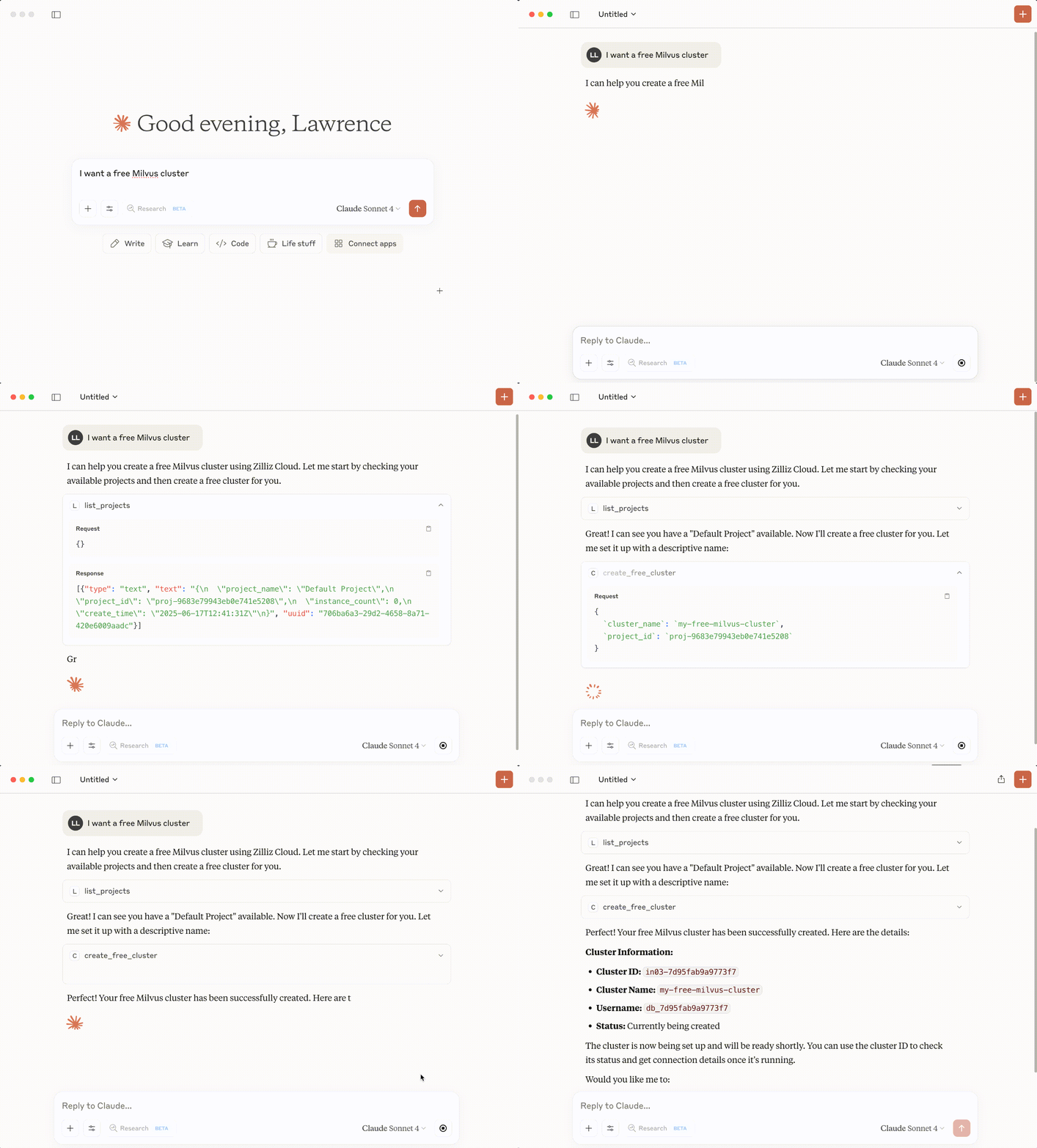 Instead of navigating through web interfaces or complex setup processes, you can get a free, fully functional vector database cluster up and running it directly from Claude, Cursor or any other MCP-compatible AI coding assistants with the Zilliz MCP Server.
The Zilliz MCP server automatically:
- Provisions a free Milvus cluster using Zilliz Cloud
- Handles authentication and configuration
- Returns connection details for immediate use
No need to leave your AI chat interface or manually set up infrastructure. Just ask in natural language and get a working vector database within seconds. This works in any MCP-enabled environment, including Claude's web interface as shown above.
Demo 2: Monitor cluster performance without leaving your chat
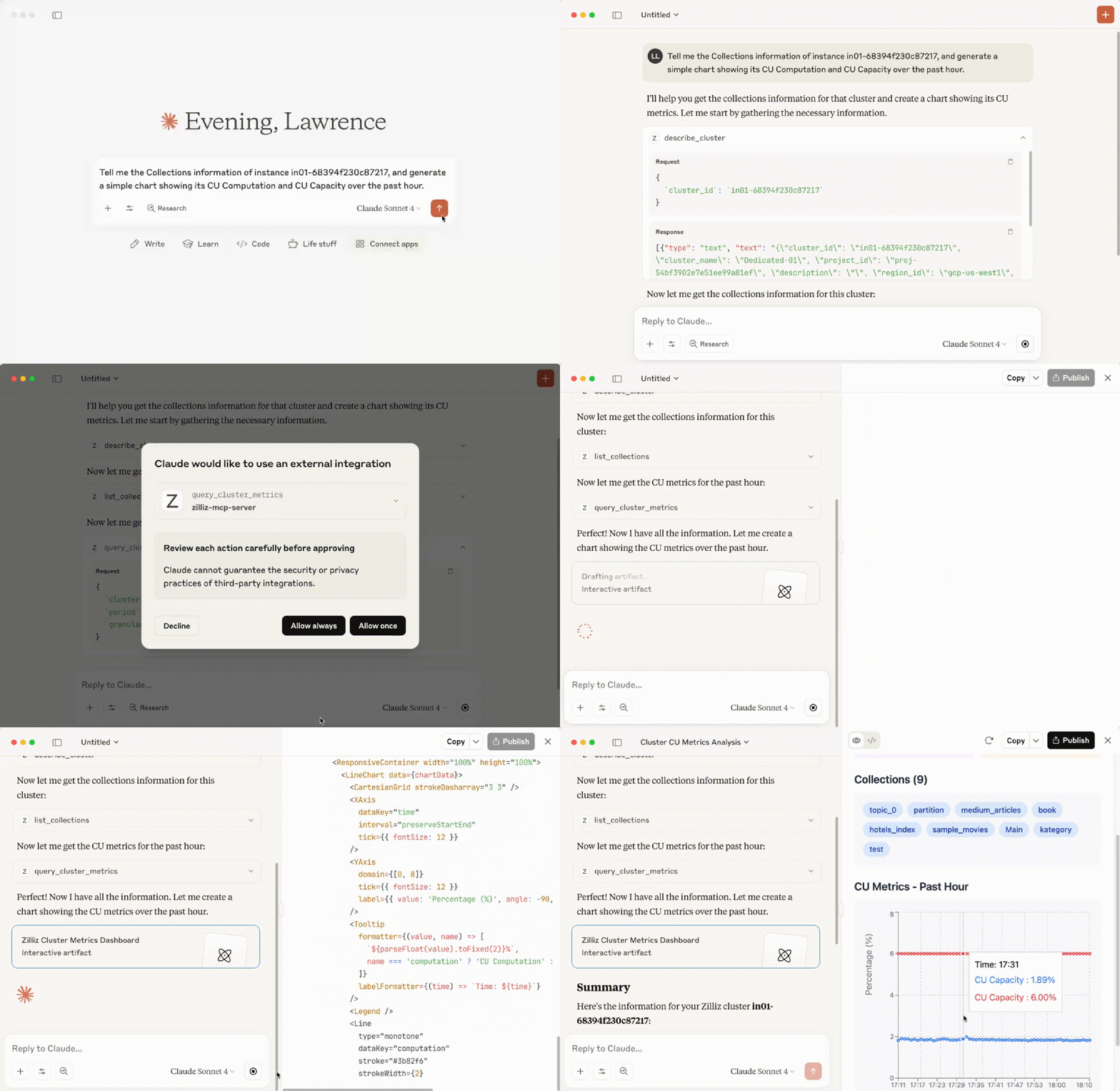 Once you have a cluster running, you can inspect its status and generate visualizations directly through natural language:
The Zilliz MCP server:
- Retrieves real-time cluster metrics and collection details
- Fetches performance data (CPU computation, capacity usage)
- Generates visualizations on demand
- All without writing queries or accessing monitoring dashboards
This demonstrates how you can monitor and analyze your vector database infrastructure conversationally, making cluster management as simple as asking questions in plain English.
Demo 3: Perform semantic search directly from your chat
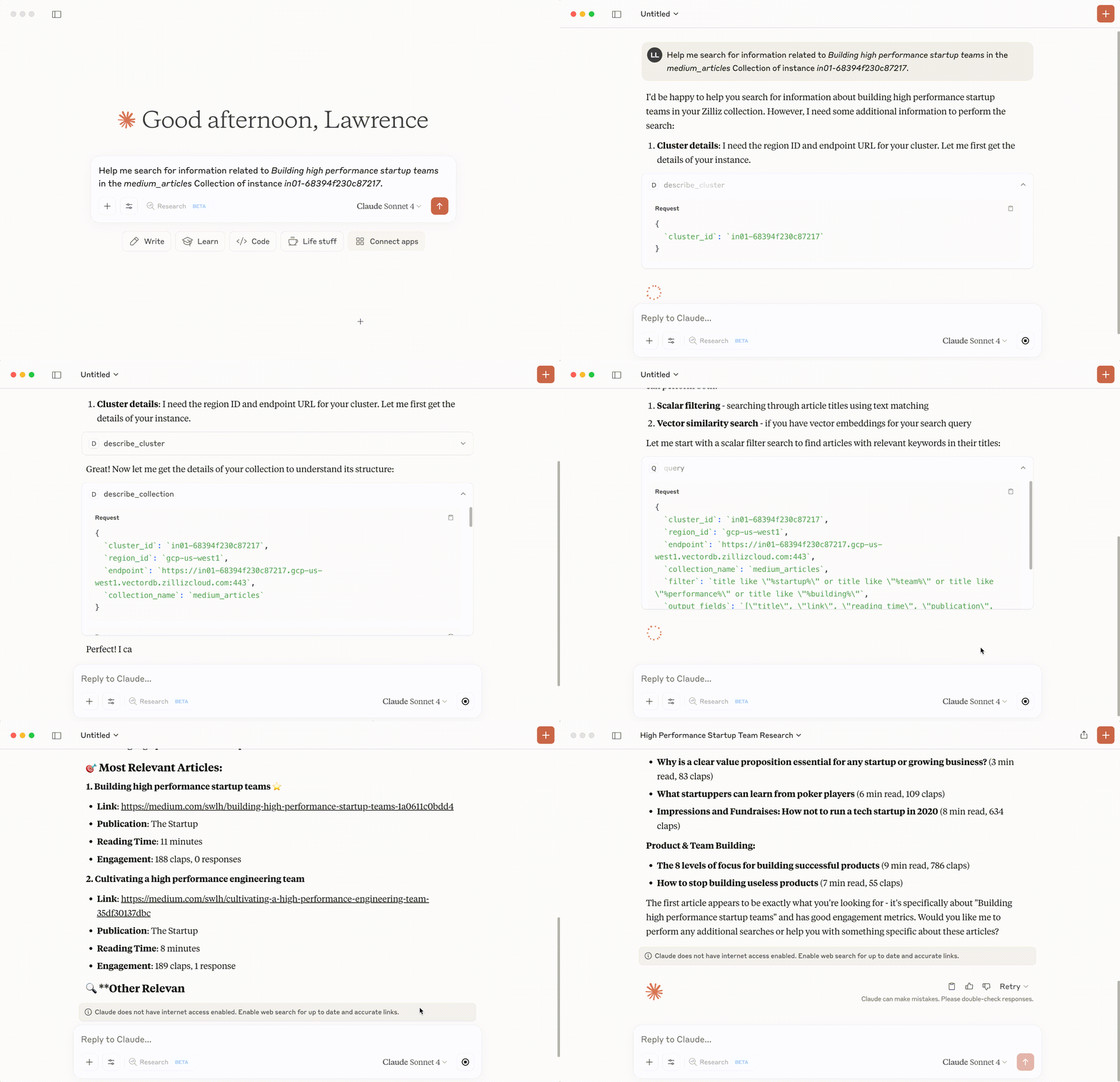 Search your vector collections using natural language without writing any code:
The Zilliz MCP server:
- Performs semantic search across your specified collection
- Returns relevant results with similarity scores
- All through conversational interface - no SDK calls or query syntax required
This shows how vector search becomes as simple as describing what you're looking for. Perfect for testing search queries, exploring your data, or building search functionality without leaving your development environment.
3. Requirements
Python: 3.10 or higher.
uv: A fast Python package installer and resolver. If you don't have it, run brew install uv on OSX, or just run curl -LsSf https://astral.sh/uv/install.sh | sh .
A Zilliz Cloud account: sign up for free if you haven't tried Zilliz Cloud before. If you already have one, sign in here.
Zilliz Cloud API Key: You'll need an API key to interact with Zilliz Cloud. You can get one by following the instructions here: Manage API Keys.
4. Usage
You can start the server in two ways:4.1. Standard I/O (StdIO)
This method is useful when the agent and the MCP server are running on the same machine and you want the agent to manage the server's lifecycle directly. The agent communicates with the server over its standard input and output streams.
Configure your agent's MCP JSON file like this:
{
  "mcpServers": {
    "zilliz-mcp-server": {
      "command": "uvx",
      "args": ["zilliz-mcp-server"],
      "env": {
          "ZILLIZ_CLOUD_TOKEN": "your-token-here"
      }
    }
  }
}
/path/to/your/zilliz-mcp-server with the actual absolute path to the project directory.
4.2. Streamable HTTP
This method runs the server as a standalone HTTP service. This is useful for development and for agents that can communicate over HTTP.
First, clone or download the project repository.
git clone https://github.com/zilliztech/zilliz-mcp-server.git
cd zilliz-mcp-server
Next, create a .env file from the example and fill in your Zilliz Cloud API key.
cp example.env .env
Now, open .env and add your API key:
ZILLIZ_API_KEY="your_api_key_here"
It 'll start the MCP server as a standalone HTTP service
uv run src/zilliz_mcp_server/server.py --transport streamable-http
After starting the server, you can configure your MCP client to connect to it. If the server is running correctly, the available tools will appear in your client's tool list (e.g., in Cursor or Claude).
You can then configure your agent or MCP client to connect to it using a configuration like this:
{
  "mcpServers": {
    "zilliz-mcp-server": {
      "url": "http://localhost:8000/mcp",
      "transport": "streamable-http",
      "description": "Zilliz Cloud and Milvus MCP Server"
    }
  }
}
5. Available Tools
The server exposes two categories of tools for your AI agents.
Zilliz Control Plane Tools
These tools are for managing your Zilliz Cloud resources.
| Tool Name | Description |
| --------------------- | ---------------------------------------------------- |
| list_projects | List all projects in your Zilliz Cloud account. |
| list_clusters | List all clusters within your projects. |
| create_free_cluster | Create a new, free-tier Milvus cluster. |
| describe_cluster | Get detailed information about a specific cluster. |
| suspend_cluster | Suspend a running cluster to save costs. |
| resume_cluster | Resume a suspended cluster. |
| query_cluster_metrics | Query various performance metrics for a cluster. |
Milvus Data Plane Tools
These tools are for interacting with the data inside a Milvus cluster.
| Tool Name | Description |
| --------------------- | ------------------------------------------------------------------------ |
| list_databases | List all databases within a specific cluster. |
| list_collections | List all collections within a database. |
| create_collection | Create a new collection with a specified schema. |
| describe_collection | Get detailed information about a collection, including its schema. |
| insert_entities | Insert entities (data records with vectors) into a collection. |
| delete_entities | Delete entities from a collection based on IDs or a filter expression. |
| search | Perform a vector similarity search on a collection. |
| query | Query entities based on a scalar filter expression. |
| hybrid_search | Perform a hybrid search combining vector similarity and scalar filters. |
Sign in to leave a review
Use Google, GitHub, or an email account so ratings stay tied to real people.
No reviews posted yet.