
Basic Memory
About
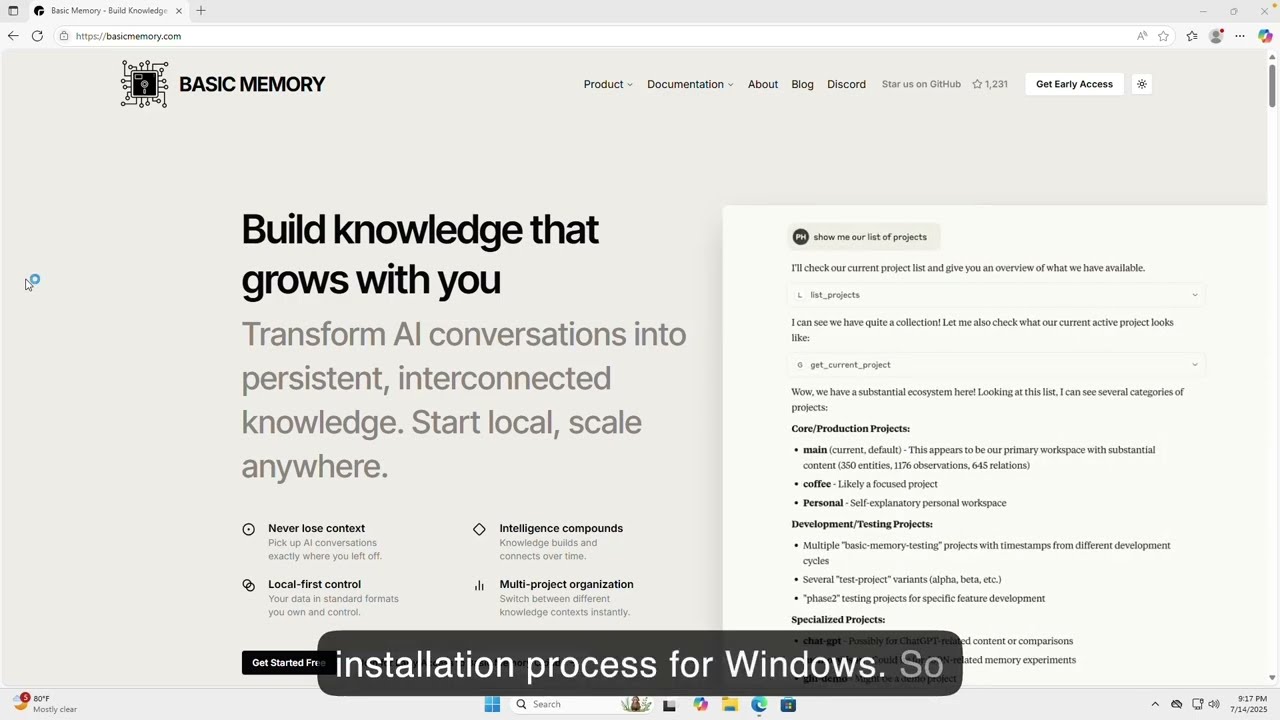
Knowledge management system that builds a persistent semantic graph in markdown, locally.
Details
- Repository
- basicmachines-co/basic-memory
- License
- AGPL-3.0
Explore
- Local-first, plain text Markdown on your disk
- Two-way sync between AI and human edits
- Real knowledge graph with observations and wikilinks
- Semantic search by meaning, not just keywords
- MCP-native, works with every major AI client
- Progressive tool discovery with behavior hints

Setting up with Highlight
This MCP is not yet compatible with Highlight’s one-click setup. However, you can still use it with Highlight by following these steps:
- Download and install Highlight from highlightai.com/download
- Navigate to the plugins tab and select "Add Custom Plugin"
-
Configure the plugin with the settings below
Plugin Name
Basic MemoryCommand (node, npx, python, etc.)uvxArguments-
Argument 1
basic-memory -
Argument 2
mcp
Please refer to the README for specific instructions on how to obtain API keys or other required environment variables.
-
Argument 1
- Enable "Start Automatically" if you want the plugin to start when Highlight launches





From the repository
Claude, Codex, or Cursor connected in 30 seconds. No Python, no JSON, no
terminal. $15.00/mo locked in for life (12.50/mo yearly pricing). 7-day free
trial — cancel any time before day 7 if it's not for you. Beta pricing —
sign up now and your rate never goes up. OSS users: code BMFOSS takes
another 20% off for 3 months.
write_note
Creates a new note with the specified content.
read_note
Retrieves the content of a specified note.
edit_note
Modifies an existing note with new content.
move_note
Moves a note from one location to another.
delete_note
Deletes a specified note.
read_content
Reads the content of a note or project.
view_note
Displays a specified note in a readable format.
search_notes
Searches for notes matching the specified criteria.
recent_activity
Shows the most recent actions taken within the memory.
list_directory
Lists all notes or files within a specified directory.
build_context
Navigates and builds context from memory URLs.
list_memory_projects
Lists all memory projects available.
list_workspaces
Lists all workspaces configured in the memory.
create_memory_project
Creates a new memory project with the specified parameters.
delete_project
Deletes a specified memory project.
schema_infer
Infers the schema of the current knowledge base.
schema_validate
Validates the schema of the current knowledge base.
schema_diff
Compares and shows differences in the schema.
search
Performs a search operation based on specified criteria.
fetch
Fetches specific data or notes based on the provided parameters.
basic_memory_diagnostics
Runs diagnostics on the Basic Memory system for health checks.
Claude Desktop / Cursor
Paste into your MCP client config file to install this server.
{
    "mcpServers": {
        "basic memory": {
            "cwd": "~/Library/Application Support/Claude",
            "env": {},
            "args": [
                "basic-memory",
                "mcp"
            ],
            "shell": false,
            "command": "uvx"
        }
    }
}Linux
{
    "cwd": "~/.config/Claude",
    "env": [],
    "args": [
        "basic-memory",
        "mcp"
    ],
    "shell": false,
    "command": "uvx"
}
Macos
{
    "cwd": "~/Library/Application Support/Claude",
    "env": [],
    "args": [
        "basic-memory",
        "mcp"
    ],
    "shell": false,
    "command": "uvx"
}
Windows
{
    "cwd": "%APPDATA%\\Claude",
    "env": [],
    "args": [
        "basic-memory",
        "mcp"
    ],
    "shell": false,
    "command": "uvx"
}
Skip the install — try Basic Memory in the cloud
Claude, Codex, or Cursor connected in 30 seconds. No Python, no JSON, no terminal.$15.00/mo locked in for life(12.50/mo yearly pricing). 7-day free trial — cancel any time before day 7 if it's not for you. Beta pricing — sign up now and your rate never goes up. OSS users: codeBMFOSStakes another 20% off for 3 months.
Give your team a single, shared cloud workspace. Knowledge isn't confined to one person — anything a teammate writes is immediately available to everyone else and to their AI assistants. Edit a note together in real time, hand work off between humans and agents, and build one connected knowledge base instead of scattered copies. Same pricing - start with one user and add more as needed.
Pick up right where you left off — in Claude, Codex, Cursor, ChatGPT, or anything that speaksMCP. Your knowledge lives as Markdown files that both you and your AI can read, write, and search.
- Local-first.Plain text on your disk. Forever.
- Two-way.AI and humans write to the same files; sync keeps them in step.
- A real knowledge graph.Observations and wikilinks compound into context.
- Semantic search.Find notes by meaning, not just keywords, with optional cross-encoder reranking for higher-quality vector and hybrid results.
- MCP-native.Works with every major AI client and IDE.
- Progressive tool discovery.Every tool is tagged with behavior hints (read-only, destructive, idempotent) so agents pick the right tool on demand — no wasted context trying things to see what they do.
- Cloud, optional.Sync across devices when you want — never required.
Pick the path that fits you. Both run the same product on the same Markdown.
30 seconds.Sign up, connect your AI client, done.
- Works in any browser
- Mobile, web, desktop
- Cross-device sync built in
- We handle hosting, backups, snapshots
$15.00/mo locked for life· 7-day free trial · cancel any time
2 minutes.Install, configure your AI client, run.
- Free forever (AGPL-3.0)
- All data on your disk
- Air-gapped friendly
- Requires Python viauv
For Postgres deployments that store semantic vectors in Milvus, install the first-party optional extra instead:
uv tool install "basic-memory[milvus]"
Basic Memory changed my whole relationship with LLMs. I switched from GPT and Gemini to exclusively Claude and Claude Code because of this integration and am completely revamping all our company's processes around a Basic Memory workflow.
Basic Memory is the missing 'wow' factor in AI chatbots. Now I can't imagine Claude or Claude Code without it.
I don't code without Basic Memory anymore. It's such a time saver to be able to refer to projects I don't currently have active and keep a running log of all my learnings and ProTips.
The hosted version of Basic Memory. Same product, same Markdown files, same MCP tools — we just host the database, run the sync, and put it on your phone.
- Every device, same brain.Your knowledge graph on web, mobile, and desktop. No copy-paste between machines.
- Connect any MCP client.Claude Desktop, Claude Code, Codex, Cursor, ChatGPT (Custom GPTs), VS Code — one-click connect from the web app.
- Bidirectional sync to local.Edit on your phone, see it in Obsidian on your laptop. rclone-powered with conflict resolution.
- Snapshots and backups.Point-in-time restore. Browse history. Never lose a note.
- No lock-in.Your notes are plain Markdown. Export to local Markdown any time — same files, same format, same wikilinks. Cancel anytime, your data stays yours.
Built on WorkOS AuthKit, Neon Postgres, and Tigris S3.
- 7-day free trial. Cancel any time before day 7 if it's not for you.
- Cancel anytime after that too — export your notes whenever you want.
- OSS users: codeBMFOSSfor another 20% off for 3 months (~$11.40/mo).
Both paths use the same OSS engine and the same Markdown files. There's no lock-in either way — flip between them when your needs change.
This repository is also the canonical home for Basic Memory's host-native agent packages. The core Python package, Claude Code plugin, shared skills, Hermes plugin, and OpenClaw plugin all ship from the same source tree.
Maintainers can verify the whole consolidated surface from the repo root:
Package-local justfiles are also available when working inside one host:
just package-check-claude-code just package-check-skills just package-check-hermes just package-check-openclaw
The Claude Code plugin is the bridge between Claude's working memory and Basic Memory — session-start briefings, pre-compaction checkpoints, an opt-in capture output style, and/basic-memory:bm-setup·:remember·:share·:status.
Connect the Basic Memory MCP server first— seeConnect your AI client. The plugin's hooks and skills call it, so it's a hard prerequisite. Then add the marketplace and install:
claude plugin marketplace add basicmachines-co/basic-memory \ --sparse .claude-plugin plugins/claude-code claude plugin install basic-memory@basicmachines-co
Framework-agnosticSKILL.mdfiles live inskills/. If your Skills CLI supports repository subdirectory sources:
npx skills add basicmachines-co/basic-memory/skills
If your installed Skills CLI cannot load that source, update the CLI or copy thememory-directories fromskills/into your agent's skills directory.
Hermes keeps its native plugin shape underintegrations/hermes:
hermes plugins install basicmachines-co/basic-memory --path integrations/hermes
If your Hermes build lacks subpath installs, use the final deprecatedbasicmachines-co/hermes-basic-memorypointer release until host support lands.
OpenClaw stays package-native and publishes fromintegrations/openclaw:
openclaw plugins install @basicmemory/openclaw-basic-memory
https://github.com/user-attachments/assets/a55d8238-8dd0-454a-be4c-8860dbbd0ddc
If you went theCloudroute, the web app walks you through client connect. The snippets below are for local installs.
Edit~/Library/Application Support/Claude/claude_desktop_config.json:
{ "mcpServers": { "basic-memory": { "command": "uvx", "args": ["basic-memory", "mcp"] } } }
Restart Claude Desktop. Notes live in~/basic-memoryby default.
claude mcp add basic-memory -- uvx basic-memory mcp
For the full memory bridge — session briefings, pre-compaction checkpoints, and the/basic-memory:commands — also install theClaude Code pluginon top of this.
[mcp_servers.basic-memory] command = "uvx" args = ["basic-memory", "mcp"]
Codex can keep its default MCP approval behavior, or you can pre-approve eligible Basic Memory tools by adding this server-scoped setting to the same table:
[mcp_servers.basic-memory] command = "uvx" args = ["basic-memory", "mcp"] default_tools_approval_mode = "approve"
This does not disable Codex approvals globally or expand which Basic Memory projects the server can access. Codex still requires approval for tools that advertise a destructive annotation, including Basic Memory's writes, edits, and deletes. If you installed the Basic Memory Codex plugin, use itsplugin-scoped configurationinstead.
Add to.cursor/mcp.json(project) or~/.cursor/mcp.json(global):
{ "mcpServers": { "basic-memory": { "command": "uvx", "args": ["basic-memory", "mcp"] } } }
{ "mcp": { "servers": { "basic-memory": { "command": "uvx", "args": ["basic-memory", "mcp"] } } } }
Basic Memory exposes OpenAI-compatiblesearchandfetchtools for Custom GPT actions. See theChatGPT integration guide.
No setup. Point Obsidian at~/basic-memory(or your project folder) and the same wikilinks, frontmatter, and Markdown your AI writes appear in your graph view. Edit either side — sync handles the rest.
"Create a note about our project architecture decisions." "Find information about JWT auth in my notes." "What have I been working on this week?"
- Automatic updates.Basic Memory keeps itself up to date foruv tooland Homebrew installs;bm updatetriggers a manual check.
- Semantic vector search.Find notes by meaning, not just keywords. Hybrid full-text + vector ranking with FastEmbed embeddings, on SQLite or Postgres.
- Optional search reranking.Rescore the strongest vector and hybrid candidates with a local FastEmbed cross-encoder or a LiteLLM-backed provider.
- Schema system.Infer, validate, and diff the structure of your knowledge base withschema_infer,schema_validate,schema_diff.
- Per-project cloud routing.Route individual projects through the cloud while others stay local, via API key (bm project set-cloud).
- Smarter editing.edit_noteappend/prepend auto-creates notes when missing;write_noteguards against accidental overwrites.
- Richer search results.Matched chunk text is included so the LLM gets context, not just hits.
- FastMCP 3.0 + tool annotations.Every tool ships with MCP behavior hints (readOnlyHint,destructiveHint,idempotentHint,openWorldHint) so agents can discover capabilities progressively at runtime instead of guessing or burning tokens.
- CLI overhaul.--jsonoutput for scripting, workspace-aware commands, and an htop-inspired project dashboard.
Reranking adds a second relevance pass after vector or hybrid retrieval. It is disabled by default because it adds inference latency and, for the local provider, a first-run model download. Text, title, and permalink searches keep their existing ranking.
Enable the default local FastEmbed reranker:
export BASIC_MEMORY_SEMANTIC_SEARCH_ENABLED=true export BASIC_MEMORY_RERANKER_ENABLED=true
The default model isjinaai/jina-reranker-v1-tiny-en. To use a hosted reranker through LiteLLM instead:
export BASIC_MEMORY_SEMANTIC_SEARCH_ENABLED=true export BASIC_MEMORY_RERANKER_ENABLED=true export BASIC_MEMORY_RERANKER_PROVIDER=litellm export BASIC_MEMORY_RERANKER_MODEL=cohere/rerank-v3.5 export COHERE_API_KEY=...
The feature fails fast on invalid configuration and does not silently fall back to retrieval order when an enabled provider fails. See thesemantic search guidefor provider setup, all settings, tuning, pagination, and failure behavior.
Most LLM conversations are ephemeral. You ask a question, get an answer, then everything is forgotten. Workarounds have limits:
- Chat historycaptures conversations but isn't structured knowledge.
- RAGlets the LLM query your documents but not write back to them.
- Vector DBsneed complex infra and usually live in someone else's cloud.
- Knowledge graphsneed specialized tooling to maintain.
Basic Memory takes a simpler path:structured Markdown files that humans and LLMs both read and write.
- All knowledge stays in plain files you control.
- Both sides read and write to the same files.
- Familiar Markdown with semantic patterns — no new format to learn.
- A traversable graph the LLM can follow link by link.
- Works with the editors you already use (Obsidian, VS Code, anything).
- Just files plus a local SQLite index. No servers required.
You're chatting normally about coffee:
I've been experimenting with brewing methods. Pour over gives more clarity than French press, water at 205°F seems best, and freshly ground beans make a huge difference.
"Make a note on coffee brewing methods."
A Markdown file appears in your project directory in real time:
--- title: Coffee Brewing Methods permalink: coffee-brewing-methods tags: [coffee, brewing] --- # Coffee Brewing Methods ## Observations - [method] Pour over highlights subtle flavors over body - [technique] Water at 205°F (96°C) extracts optimal compounds - [principle] Freshly ground beans preserve aromatics ## Relations - relates_to [[Coffee Bean Origins]] - requires [[Proper Grinding Technique]] - affects [[Flavor Extraction]]
Next session, the LLM picks up the thread. It follows the relations to surface what you already know about Ethiopian beans and burr grinders, and builds on it instead of starting over. You see the same files in Obsidian or your editor. Edit them by hand — the AI sees your changes too.
Real two-way flow: humans edit Markdown, LLMs read/write through MCP, sync keeps everything consistent, and the source of truth is always your files.
Each file is anEntity. Entities haveObservations(facts about them) andRelations(links to other entities). That's the whole grammar.
--- title: <Entity title> type: note permalink: <uri-slug> tags: [optional, list] ---
Facts about the entity. Categories in[brackets], tags with#, optional context in parens.
- [method] Pour over highlights subtle flavors - [tip] Grind medium-fine for V60 #brewing - [fact] Lighter roasts contain more caffeine than dark - [resource] James Hoffmann's V60 technique on YouTube - [question] How does temperature affect compound extraction?
Wiki-style links that form the graph. Single-token relation types, or quote multi-word ones.
- pairs_well_with [[Chocolate Desserts]] - grown_in [[Ethiopia]] - requires [[Burr Grinder]] - "pairs well with" [[Dark Chocolate]]
Bare- [[Target]]and prose- Worth checking out [[Target]]index aslinks_to. Full reference in thedocs.
Basic Memory exposes these tools to any MCP client. Every tool is annotated with MCP behavior hints (read-only, destructive, idempotent, open-world) so agents can pick the right one without trial-and-error:
Sign in to leave a review
Use Google, GitHub, or an email account so ratings stay tied to real people.
No reviews posted yet.